
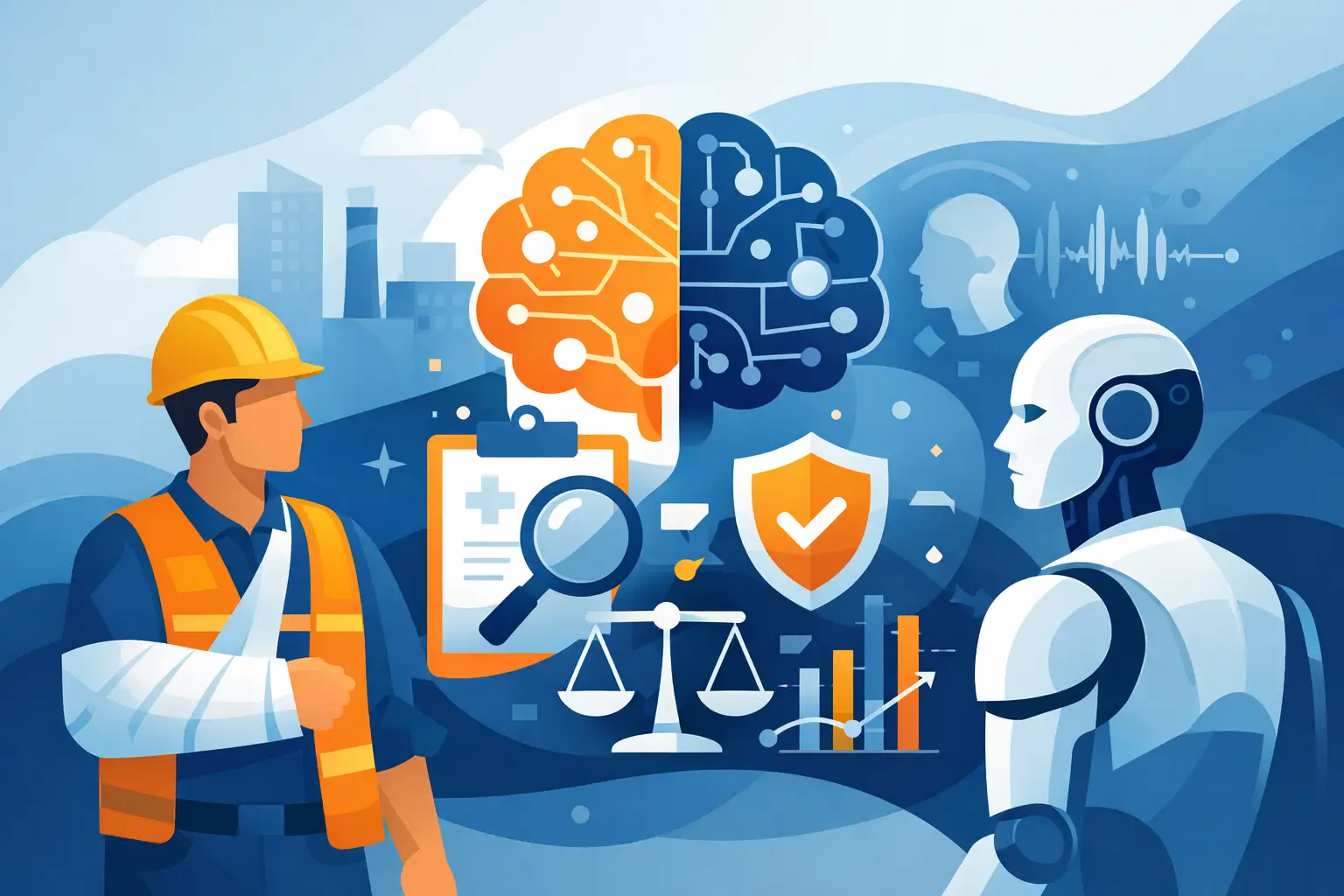
A claim sits untouched for 48 hours because the examiner is carrying an overloaded desk. An injured worker, uncertain and frustrated, calls twice and gets no clear next step. A nurse case manager spends more time hunting for documentation than coordinating care. This is where ai in workers compensation gets real – not as a futuristic concept, but as an operational decision with consequences for cycle time, litigation risk, worker trust, and return-to-work results.
For workers’ compensation leaders, the question is no longer whether AI will enter the claims workflow. It already has. The better question is where AI produces measurable value, where human judgment remains non-negotiable, and how organizations can train professionals to use it without weakening compliance, empathy, or claim quality.
Where ai in workers compensation is gaining traction
The strongest use cases are not flashy. They are administrative, repetitive, and data-heavy. AI can help classify incoming documents, summarize medical records, flag missing claim information, identify potential severity indicators, and support early triage decisions. In environments where adjusters and support staff are under volume pressure, these functions can reduce lag and create faster task visibility.
That matters because delay has a cost. A slow first contact can increase worker anxiety. Incomplete intake can create downstream confusion. Late identification of psychosocial barriers can push a claim toward extended disability and attorney involvement. When applied carefully, AI can surface patterns that busy teams may miss in the first 24 to 72 hours.
Claims organizations are also using AI to support documentation quality. A system may draft claim notes from structured data, organize medical updates by body part or treatment phase, or identify inconsistencies across forms, provider reports, and prior claim history. This does not replace the examiner. It gives the examiner a cleaner starting point.
On the employer side, AI can improve trend analysis across injury types, departments, provider utilization, and claim duration. Risk managers and self-insured employers often struggle less with lack of data than with lack of usable interpretation. AI can help transform large claim datasets into patterns that support prevention strategy, vendor management, and training priorities.
The business case is speed, consistency, and better signal detection
The appeal of AI in workers compensation is easy to understand when viewed through an operational lens. Claims teams need faster throughput without sacrificing quality. Supervisors need more consistency across desks. Executives need lower leakage, better return-to-work outcomes, and fewer avoidable escalations. AI appears to offer all three.
Sometimes it does. If a model helps flag high-risk claims earlier, the organization may intervene sooner with clinical coordination, supervisor review, employer engagement, or expectation-setting with the injured worker. If AI reduces manual sorting and repetitive note handling, the claims professional has more time for meaningful communication. If it helps identify reserve anomalies or potential compliance deadlines, it may reduce preventable errors.
But there is a difference between automation and improvement. Faster processing is only valuable if it supports better decisions. A poorly designed workflow can scale bad habits just as efficiently as good ones.
What AI should not do in workers’ compensation
Workers’ compensation is not a simple transaction environment. It sits at the intersection of medicine, employment, law, state regulation, disability duration, and human stress. That is exactly why overconfidence in automation creates risk.
AI should not be treated as an autonomous decision-maker for compensability, clinical appropriateness, return-to-work readiness, or worker credibility. These are judgment-heavy questions that depend on facts, context, state-specific standards, and communication quality. A model can assist by organizing information or identifying patterns. It cannot carry professional accountability.
It also should not become a substitute for direct human contact. Injured workers do not measure claim quality only by whether forms were processed quickly. They measure it by whether someone listened, explained the process, set expectations, and treated them with respect. An efficient system that feels cold or opaque can still produce dissatisfaction, mistrust, and litigation.
This is where many organizations get the strategy wrong. They adopt AI to reduce administrative burden, which is reasonable, but then allow that efficiency mindset to crowd out the relational work that actually stabilizes claims. In workers’ compensation, communication is not a soft extra. It is a claim outcome variable.
The training gap is bigger than the technology gap
Most organizations do not have an AI problem. They have a workforce readiness problem.
A claims professional who receives an AI-generated summary still needs to verify what matters, identify what is missing, and recognize when the summary is framing the claim too narrowly. A nurse case manager using AI-assisted documentation still needs clinical judgment, professional skepticism, and communication skill. A supervisor reviewing AI-supported triage outputs still needs to know when escalation is appropriate and when a claim requires a more human-centered intervention.
Without training, AI can produce a false sense of precision. The output looks polished, so people trust it too quickly. That creates exposure in compensability analysis, medical management, compliance handling, and reserve strategy. It can also reinforce bias if historical claim patterns are treated as neutral truth rather than legacy behavior that deserves scrutiny.
This is why education must extend beyond tool adoption. Teams need structured training on prompt discipline, data interpretation, documentation review, workflow controls, and role-specific quality assurance. Just as important, they need training on the human elements that AI cannot supply – empathy, expectation-setting, conflict de-escalation, and recovery-focused communication.
In a whole-person recovery model, technology supports professionals. It does not define professionalism.
Governance matters more than enthusiasm
When organizations discuss AI, the conversation often starts with productivity. It should start with governance.
What data is being used? Who validates outputs? How are errors documented and corrected? What claims decisions are prohibited from automation? How are state-specific requirements handled? Who is accountable when AI-generated content is inaccurate, incomplete, or misleading?
These are not abstract policy questions. They affect regulatory exposure, claim file defensibility, audit performance, and stakeholder confidence. In workers’ compensation, one unsupported recommendation or one poorly documented claim action can carry financial and legal consequences well beyond the administrative task that triggered it.
Good governance also protects the injured worker experience. If a chatbot answers basic process questions after hours, that may be helpful. If it gives a confusing response about benefits, return to work, or medical care, the damage can outweigh the convenience. Every AI touchpoint should be evaluated for both efficiency and human impact.
How mature organizations will use AI in workers compensation
The most effective organizations will not ask AI to replace adjusters, nurses, or risk professionals. They will use it to strengthen disciplined practice.
That means deploying AI first in bounded, auditable use cases. Think document organization, note summarization, deadline support, trend identification, and intake assistance. These functions are easier to monitor and less likely to distort high-stakes judgment if managed properly.
It also means building escalation rules that keep humans in control. If a claim shows indicators of delayed recovery, psychosocial complexity, attorney involvement, comorbidity, or employer communication breakdown, the workflow should move toward more skilled human intervention, not less.
The organizations that gain the most will pair technology adoption with formal education. They will train examiners to review AI outputs critically. They will train leaders to measure quality, not just speed. They will train teams to communicate with injured workers in ways that reduce confusion and preserve trust. This is where specialized education providers such as WorkCompCollege fit the market need – not by promoting AI as a shortcut, but by teaching professionals how to use it within a stronger claims and recovery framework.
The real opportunity is not fewer people, but better practice
There is a tempting narrative that AI will solve workforce strain by replacing expertise. In workers’ compensation, that is the wrong frame. The better opportunity is to reduce low-value administrative friction so professionals can spend more time on the parts of the claim that actually change outcomes.
That includes timely worker contact, early barrier identification, employer coordination, return-to-work planning, and clear, respectful expectation-setting. These are not side tasks. They are central to claim performance.
AI may help organizations move faster, spot patterns sooner, and operate with more consistency. Those are meaningful gains. But the claim still turns on whether the professional handling it can combine technical accuracy with judgment, empathy, and accountability.
That is the future worth building: a workers’ compensation system where technology improves capacity, but people still carry the work that requires trust.