
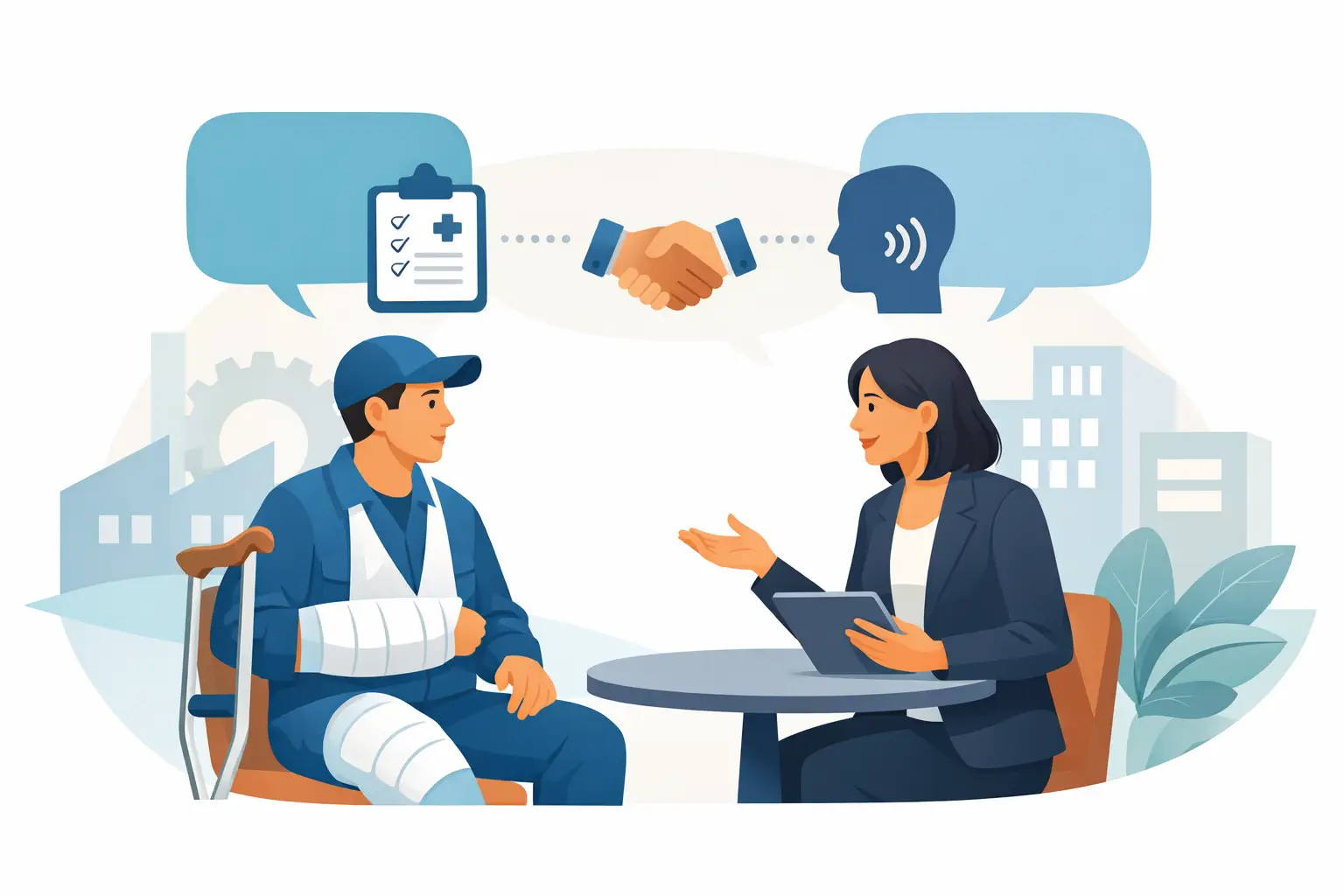
A claim can go off track long before indemnity exposure spikes or attorney representation appears in the file. Often, the first warning sign is simpler: the injured worker does not know what is happening, what comes next, or who is accountable. If you want to improve injured worker communication, you are not polishing customer service. You are addressing a core claims performance variable that directly affects trust, recovery, duration, and cost.
In workers’ compensation, communication failures rarely stay isolated. A missed callback becomes confusion about benefits. Confusion turns into suspicion. Suspicion creates disengagement, delayed treatment adherence, employer tension, and in many cases legal escalation. Organizations that treat communication as a measurable professional competency, rather than a personality trait, are far better positioned to stabilize claims early.
Why injured worker communication affects claim outcomes
The business case is straightforward. Injured workers who feel ignored or poorly informed are more likely to question claim decisions, seek outside guidance, and disengage from the recovery process. That does not mean every represented claim is caused by communication failure. It does mean poor communication increases the odds that normal claim friction becomes adversarial.
This matters operationally because workers’ compensation is not a one-touch transaction. It is an ongoing process involving medical care, work status updates, statutory deadlines, employer coordination, and benefit explanations. When communication is inconsistent, each handoff introduces risk. The injured worker may hear one message from the adjuster, another from the employer, and a third from the provider office. Even when each party is acting in good faith, misalignment undermines confidence.
Strong communication also supports better return-to-work outcomes. Employees are more likely to participate constructively when expectations are clear, restrictions are explained, and transitional work is presented as part of recovery rather than as pressure. The difference is not semantic. It is clinical, relational, and financial.
The real barriers to improve injured worker communication
Most organizations do not struggle because their professionals do not care. They struggle because communication is often undertrained, inconsistently defined, and weakly measured.
Many claims teams are evaluated on speed, closure, diary management, and leakage control, but not on whether the injured worker actually understood the claim path. Adjusters may know the statute, the compensability framework, and the medical management protocols, yet still lack training in expectation-setting, emotional de-escalation, and plain-language explanation. Nurse case managers and employer representatives can face the same gap.
There is also a structural problem. Communication quality degrades when roles are unclear. The injured worker may not know whether to call the adjuster, the employer, the medical office, or the nurse case manager. If each party assumes someone else is handling updates, the employee experiences silence. From the organization’s perspective, nothing catastrophic happened. From the worker’s perspective, the system disappeared.
Another barrier is overreliance on scripts. Standardization matters, especially for compliance and consistency. But rigid scripts can sound detached at the exact moment an injured worker needs clarity and reassurance. Effective communication requires a disciplined approach, not a robotic one.
How to improve injured worker communication in practice
The first step is to define what good communication actually looks like. In high-performing claims organizations, it is not vague. It includes timely first contact, clear explanation of process, documented next steps, role clarity, consistent follow-up, and respectful tone. Those elements should be trainable and observable.
Early contact carries disproportionate weight. The initial conversation often shapes whether the injured worker sees the claim as organized and supportive or confusing and defensive. That first interaction should explain what the workers’ compensation process covers, what decisions are pending, when the worker should expect the next update, and how to reach the right person with questions. It should also confirm that the employee’s concerns were heard, not merely processed.
Language choice matters more than many professionals realize. Claims terminology that is routine internally can sound opaque or alarming externally. Words like compensability, utilization review, reserved rights, or modified duty may be accurate but still misunderstood. The goal is not to avoid technical accuracy. The goal is to translate it into plain language without losing precision.
Frequency is just as important as content. One of the most effective ways to improve injured worker communication is to establish communication cadence before a problem develops. A brief update that says, “Here is where things stand, here is what is still pending, and here is when you will hear from me again,” can prevent avoidable escalation. Silence invites assumptions, and assumptions are rarely favorable.
Empathy is not soft – it is operational
In workers’ compensation, empathy is sometimes treated as separate from technical excellence. That is a costly mistake. Empathy does not mean promising outcomes you cannot guarantee or avoiding difficult claim conversations. It means acknowledging the human impact of injury and communicating with enough respect that the worker can stay engaged even when the process is complex.
This is especially important when the claim involves delays, disputed issues, or work restrictions the employee did not expect. A purely transactional message may be legally sufficient and still operationally damaging. By contrast, a professional who can explain the issue, acknowledge frustration, and set realistic next steps often reduces conflict without compromising compliance.
That is one reason advanced workers’ compensation education increasingly treats communication and expectation-setting as claims management disciplines. WorkCompCollege has been notably direct on this point through its whole person recovery framework: better outcomes are not created by technical handling alone. They are created when technical handling and human-centered communication operate together.
Train for communication the same way you train for compliance
If communication affects litigation rates, return-to-work success, worker satisfaction, and claim duration, it should be trained with the same seriousness as jurisdictional rules or Medicare compliance. That means role-specific education, scenario practice, coaching, and measurable standards.
For adjusters, training should cover first-contact structure, active listening, benefit explanation, expectation-setting, and difficult conversation management. For supervisors, it should include coaching methods and audit criteria. For employers and supervisors in the field, it should include post-injury response, transitional duty communication, and how to avoid language that sounds retaliatory or dismissive. For nurse case managers and clinical stakeholders, it should reinforce alignment between medical messaging and claim messaging.
This training works best when it reflects real claims conditions. A professional does not build confidence by reading generic service principles. They build it by practicing conversations involving delayed authorizations, frustrated family members, disputed treatment, chronic pain concerns, and return-to-work resistance. Communication must be operationalized at the point where claims actually become unstable.
Measure what injured workers experience
Organizations that want better communication outcomes need more than anecdotal feedback. They need measurable indicators tied to worker experience and claim performance.
That does not require a complicated model. Start by tracking speed to first contact, follow-up timeliness, documented explanation of next steps, worker complaints related to communication, representation trends, and return-to-work outcomes by team or office. File audits should evaluate whether communication notes reflect clarity and expectation-setting, not just task completion.
There is a trade-off here. More measurement can create administrative burden if done poorly. But the answer is not to avoid measurement. It is to focus on a few indicators that reveal whether communication is reducing uncertainty or adding to it.
Leaders should also review communication performance by claim complexity. A simple medical-only claim and a psychosocially complex lost-time claim should not be evaluated in exactly the same way. The higher the complexity, the more communication discipline matters.
Better communication requires system alignment
Even skilled professionals struggle when the broader system sends mixed messages. To improve injured worker communication at scale, employers, carriers, TPAs, providers, and recovery stakeholders need aligned expectations.
That starts with role definition. The injured worker should know who handles benefits questions, who discusses work status, who coordinates medical care, and when updates will occur. Standard communication pathways reduce confusion without forcing every conversation into a script.
It also requires internal consistency. If the employer says modified duty is available but the claim file suggests uncertainty, trust erodes. If a provider’s office tells the worker one thing about authorization timing and the adjuster says another, frustration grows. Communication quality is not only about individual skill. It is also about operational coordination.
For that reason, many organizations see the strongest gains when communication improvement is approached as a workforce development issue, not as a one-time reminder to “be more empathetic.” Sustainable change comes from structured education, leadership reinforcement, and process design that supports clarity.
The workers’ compensation industry often talks about reducing friction, improving outcomes, and lowering claim costs. Those goals become more achievable when communication is treated as a professional standard with direct economic value. Injured workers do not need polished language. They need timely information, honest expectations, and evidence that the people managing their claim understand both the process and the person moving through it.