
A claim can meet every statutory requirement and still produce a poor outcome. When an injured worker does not understand the treatment plan, fears job loss, cannot reach the right person, or feels dismissed, recovery slows. The most consequential recovery management trends are responding to that operational reality: claim outcomes are shaped by human experience as much as technical claim activity.
For carriers, TPAs, self-insured employers, and provider partners, this shift is not a philosophical exercise. Delayed recovery increases indemnity exposure, medical spend, attorney involvement, administrative workload, and workforce disruption. Better recovery management means building the capability to identify barriers early, communicate with purpose, coordinate the right resources, and maintain focus on safe, sustainable function.
Recovery Management Trends Are Moving Upstream
Traditional claims models often reserve intensive attention for claims that have already become complex. By that point, a missed appointment, unresolved pain concern, breakdown in supervisor communication, or delayed authorization may have developed into extended disability or litigation.
A defining trend is earlier, more deliberate triage. Organizations are increasingly looking beyond diagnosis and injury severity at first notice of loss. They are assessing job demands, recovery expectations, psychosocial concerns, prior claim history, access to care, language needs, and the worker’s relationship with the employer. The goal is not to label people as difficult or predict failure. It is to recognize where a standard workflow may be insufficient.
Early contact is becoming a performance discipline
Early outreach is most effective when it is more than a scripted acknowledgment. A skilled claims professional explains what happens next, confirms immediate needs, sets realistic expectations, and gives the injured worker a reliable path for questions. That interaction can reduce uncertainty at the moment uncertainty is highest.
Speed matters, but quality matters more. A rushed call that sounds transactional can create the same distrust as no call at all. Training should therefore address both technical accuracy and the conversational skills required to establish credibility. Claims teams need to know how to listen for concerns, explain benefits without jargon, and document information that will guide the recovery plan.
Whole-Person Recovery Is Becoming an Operating Model
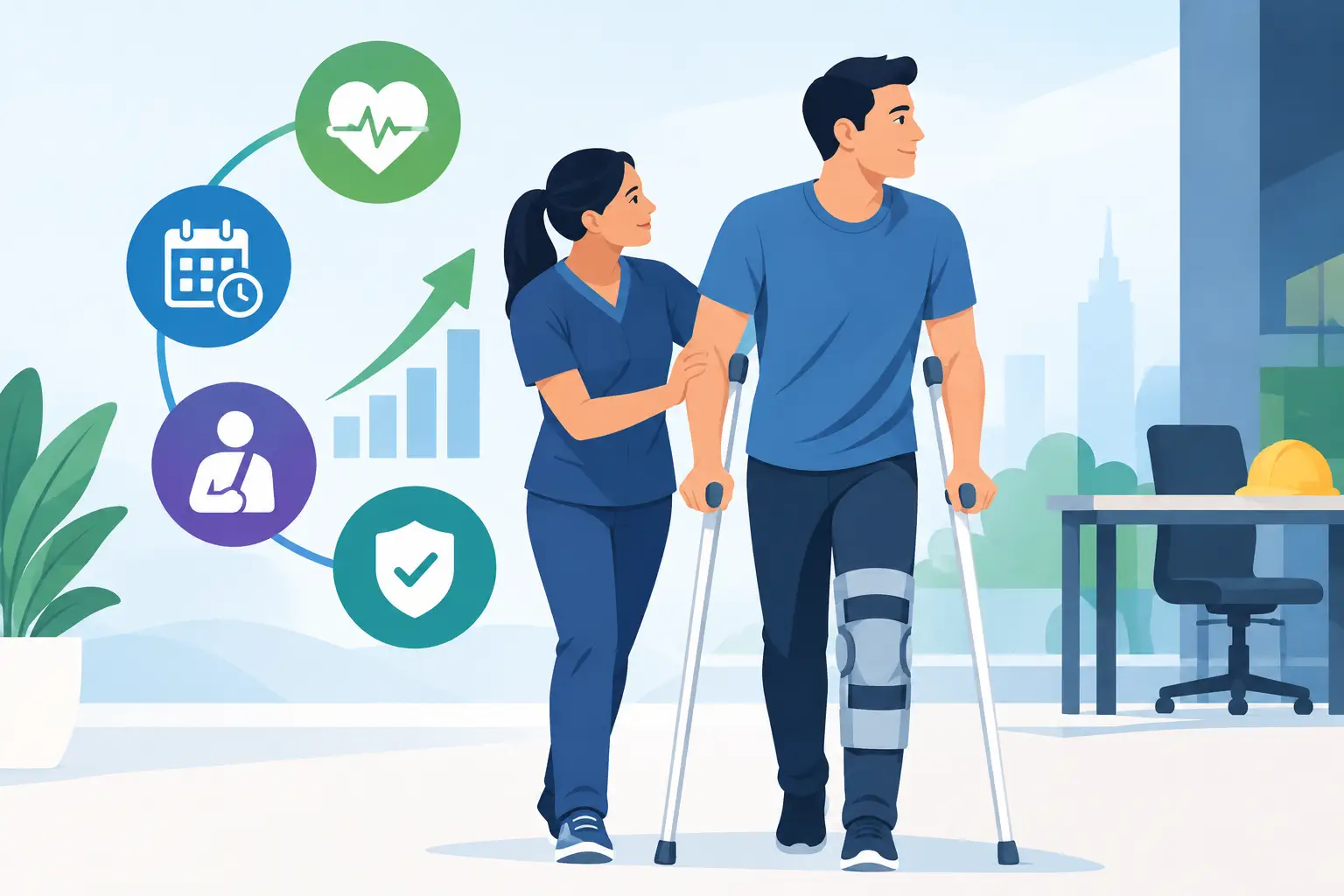
Workers’ compensation has always involved medical treatment and indemnity benefits. Recovery management is now expanding the lens to include the conditions that influence whether treatment translates into restored function. Transportation barriers, caregiving responsibilities, financial stress, health literacy, fear of reinjury, workplace conflict, and behavioral health needs can all affect a claim’s trajectory.
This does not mean every claim requires intensive case management or clinical intervention. It means the response should fit the barrier. A worker who needs clearer return-to-work expectations requires a different intervention than a worker facing a complex comorbidity or a delayed specialty referral.
The operational challenge is consistency. Whole-person recovery cannot depend on whether an individual adjuster happens to ask better questions. Organizations need defined workflows, escalation criteria, role clarity, and education that helps frontline professionals recognize when a recovery barrier is within their scope to address and when it requires coordinated support.
This model also changes the way performance is discussed. Closing a claim quickly is not always a meaningful success measure if the worker returns without appropriate support and experiences a setback. The stronger objective is durable recovery: appropriate care, safe work participation, informed expectations, and a resolution that holds.
Return to Work Is Becoming More Collaborative
Return to work remains one of the most powerful levers in workers’ compensation, but the language around it is evolving. A release to modified duty is not, by itself, a return-to-work strategy. The transition succeeds when the job is available, the restrictions are understood, the supervisor is prepared, and the employee sees a credible path back to productive work.
Forward-looking employers are involving supervisors and operational leaders earlier in the process. They are treating transitional work as a planned business function rather than an exception arranged after disability has extended. That requires supervisors to understand their role without being asked to interpret medical restrictions or manage information they should not receive.
Expectations must be aligned across the claim
Misalignment creates avoidable friction. The treating provider may believe modified duty exists, while the employee believes there is no meaningful work available. The employer may offer a role that does not match stated restrictions. The claims professional may communicate timelines that conflict with the care plan.
Recovery management requires a disciplined expectation-setting process. Every party should understand the current functional status, the next decision point, and who is responsible for action. Clear communication does not guarantee agreement, but it reduces the confusion that often drives disengagement and attorney involvement.
Data Is Becoming More Useful When It Drives Action
Claims organizations have more data than ever, including lag time, provider performance, duration benchmarks, litigation indicators, pharmacy activity, and return-to-work measures. The trend is not simply toward more analytics. It is toward practical analytics that help the right professional intervene at the right time.
A predictive model can identify a claim with elevated risk, but it cannot explain a benefit decision with empathy, resolve a worker’s unanswered concern, or persuade a supervisor to support transitional work. Data identifies where attention may be needed. Professional judgment determines what should happen next.
The most effective programs connect data to specific actions. If a claim shows delayed treatment initiation, there should be a clear ownership path. If work absence exceeds expected duration, the team should know whether to review barriers, coordinate with the employer, obtain additional clinical information, or engage specialized resources. Alerts without accountability create more work rather than better outcomes.
Organizations should also be cautious about treating models as neutral. Historical claims data can reflect inconsistent access to care, uneven communication, or prior operational bias. Governance, human review, and role-specific education are necessary to ensure that data supports fairer recovery decisions rather than merely automating old patterns.
AI Is Raising the Standard for Human Skills
Artificial intelligence is beginning to assist with claim summarization, document review, workflow prioritization, communication drafting, and pattern recognition. Used appropriately, these tools can reduce administrative burden and give claims professionals more time for complex decisions and meaningful contact.
But AI also raises the stakes for communication, critical thinking, privacy awareness, and professional accountability. A generated summary may omit context. A drafted message may be technically correct but emotionally tone-deaf. A risk score may warrant investigation, not an assumption about the worker or the claim.
The practical opportunity is to train teams to use AI as decision support rather than decision replacement. They must understand the limitations of automated outputs, protect sensitive information, verify material facts, and retain ownership of the recovery conversation. As routine tasks become faster, the differentiating skill will be the ability to apply judgment with clarity and respect.
Training Is Shifting From Compliance Completion to Capability
Compliance education remains essential, particularly as state requirements, Medicare Secondary Payer obligations, and jurisdictional rules continue to demand precision. Yet completion rates do not prove that an organization has built recovery capability.
The stronger training model is role-specific and measurable. Adjusters need claim, communication, and expectation-setting skills. Nurse case managers need coordinated approaches that connect clinical progress to functional recovery. Supervisors need practical return-to-work education. Leaders need the ability to measure whether training is improving claim handling consistency, duration outcomes, and worker experience.
This is where formal education systems such as WorkCompCollege’s Whole Person Recovery Method™ can provide a more disciplined foundation. The objective is not to make empathy a slogan. It is to teach empathy, communication, and technical claims practice as operational competencies that can reduce friction and improve outcomes.
The Competitive Difference Will Be Recovery Confidence
The organizations best positioned for the next phase of workers’ compensation will not be those with the most elaborate claim workflows. They will be the ones whose people can make sound technical decisions while helping injured workers understand what is happening, what is expected, and where support is available.
Recovery confidence is built one well-managed interaction at a time. When professionals combine timely intervention, coordinated return-to-work planning, responsible use of data, and respectful communication, they create conditions where better claim outcomes become more likely – for the worker, the employer, and the organization responsible for the claim.