

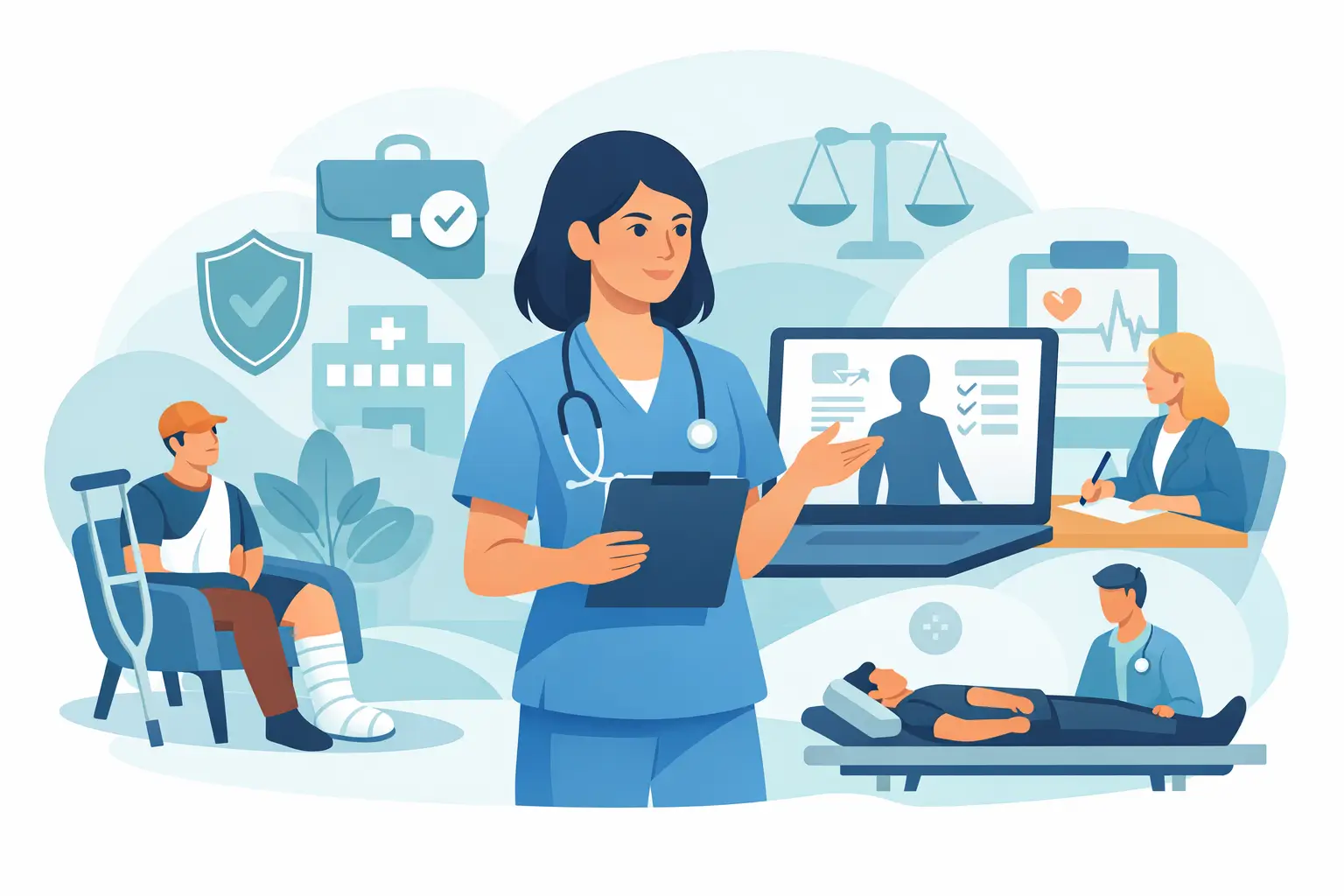
A nurse case manager can know utilization patterns, treatment pathways, and medical terminology cold – and still underperform in workers’ compensation. The gap is rarely clinical knowledge alone. It is usually workers’ compensation-specific judgment: when to escalate, how to communicate with an injured worker without inflaming distrust, how to document for claim clarity, and how to support recovery while respecting role boundaries. That is why nurse case manager workers compensation training matters as an operational discipline, not just a continuing education checkbox.
In workers’ compensation, the nurse case manager sits at a pressure point between medicine, claims, employers, providers, and injured workers. Every conversation can affect treatment direction, return-to-work timing, attorney involvement, and claim duration. When training is too generic, nurses are left to learn the system by trial and error. That is expensive for organizations and frustrating for injured workers.
What nurse case manager workers compensation training should actually cover
A strong training program must go beyond basic orientation. Nurse case managers need a working command of the claims environment they operate in, including compensability concepts, state-specific process differences, utilization review realities, return-to-work coordination, and documentation standards that support claim decision-making.
Just as important, they need training in the human side of case management. This is where many organizations still underinvest. In workers’ compensation, empathy is not soft or optional. It is a performance variable. A nurse who can set expectations clearly, explain process without jargon, de-escalate anxiety, and build trust with an injured worker can help prevent avoidable conflict that later shows up as delayed recovery, non-adherence, complaints, or litigation.
That does not mean every case requires the same approach. Some claims call for tight utilization scrutiny and frequent provider coordination. Others are more affected by psychosocial barriers, workplace tension, transportation issues, or fear about job security. Effective training teaches nurse case managers how to identify those differences early and respond accordingly.
Why generic nursing education is not enough
Traditional nursing education prepares clinicians to assess, educate, and coordinate care. Those are essential foundations. But workers’ compensation adds constraints and priorities that are not central to most clinical programs.
A nurse case manager in this setting must understand how medical progress intersects with indemnity exposure, employer accommodations, regulatory timelines, and claim reserve pressure. The nurse is not simply coordinating care in the abstract. The nurse is operating inside a statutory system with business consequences.
This distinction matters because missteps are common when training is informal. A clinically capable nurse may overcommunicate with the wrong party, underdocument a barrier to recovery, fail to frame a provider conversation around functional capacity, or miss the significance of delayed expectation-setting with the injured worker. None of these errors look dramatic in isolation. Over a portfolio of claims, they become measurable cost drivers.
The skills that separate effective nurse case managers
The strongest nurse case managers are not defined only by medical expertise. They combine clinical fluency with system awareness and disciplined communication.
They know how to read a claim as both a medical and operational event. They understand when a treatment delay is merely administrative and when it is likely to create distrust. They can translate medical updates into claim-relevant information for adjusters and employers without overstepping clinical ethics or legal boundaries.
They also know that return to work is not a paperwork milestone. It is a recovery strategy. Training should therefore include practical instruction on functional restoration, modified duty conversations, provider alignment, and employer communication. If a nurse case manager can help all parties focus on safe function rather than vague recovery language, outcomes tend to improve.
Another differentiator is documentation. In workers’ compensation, notes are not just records of contact. They are operational tools. Good training teaches nurses how to document barriers, interventions, treatment status, worker concerns, and next steps in ways that are clear, objective, and useful to the broader claim team.
Nurse case manager workers compensation training and claim outcomes
Organizations sometimes treat training as overhead when it should be evaluated as infrastructure. If nurse case managers influence treatment coordination, worker engagement, provider communication, and return-to-work planning, then their preparation affects key metrics.
Better-trained nurse case managers can contribute to shorter claim duration, fewer communication breakdowns, stronger provider alignment, and earlier recognition of psychosocial obstacles. That may reduce unnecessary attorney involvement and support more consistent return-to-work progression. It can also improve the experience of injured workers, which matters both ethically and operationally.
The return on training is not always immediate or perfectly linear. A complex claim may still become litigated. A difficult recovery may still require extended intervention. But trained professionals are more likely to recognize risk sooner, communicate more effectively, and support better decisions under pressure. That is where claims organizations gain leverage.
What decision-makers should look for in a training program
If you are selecting nurse case manager workers compensation training for an organization, start with relevance. A broad case management course is not enough if it does not address the realities of workers’ compensation claims handling.
Look for curriculum that includes claims lifecycle awareness, workers’ compensation medical management, role clarity, state and compliance sensitivity, return-to-work strategy, Medicare Secondary Payer considerations where applicable, and documentation practices tied to claim performance. The program should also address communication with adjusters, employers, attorneys, providers, and injured workers, because the nurse case manager works across all of those relationships.
The second issue is instructional philosophy. If training focuses only on hard skills, it leaves a major performance gap untouched. Communication, empathy, and expectation-setting should be taught as professional competencies with measurable operational value. In a system where mistrust can derail progress, these skills belong in formal education.
Third, consider scalability and consistency. Many organizations rely on shadow training, inherited habits, and local workarounds. That approach creates variation in quality. A structured training system allows leaders to define standards, measure completion, and build a common model for case management performance.
The case for whole-person recovery in nurse training
Workers’ compensation has often been managed as a sequence of transactions: authorize care, document status, review work ability, move the file. That model misses what experienced professionals see every day. Recovery is influenced by fear, family stress, workplace relationships, pain beliefs, transportation challenges, prior health issues, and expectations about the future.
Nurse case managers are uniquely positioned to identify those factors because they are often closest to the medical and human realities of the claim. But they can only act on that insight if they have been trained to see it as part of the job.
A whole-person recovery approach does not replace technical rigor. It strengthens it. When nurses are trained to assess psychosocial barriers alongside clinical progress, they can communicate more effectively, intervene earlier, and help the claim team respond in ways that support both recovery and claim resolution. That is one reason specialized education providers such as WorkCompCollege frame soft skills as operational drivers rather than optional interpersonal traits.
Training newer nurses versus experienced case managers
Not every learner needs the same curriculum depth. Newer nurse case managers usually need foundational education on claim structure, terminology, stakeholders, and role boundaries. They benefit from clear frameworks that explain how workers’ compensation differs from group health or hospital-based care coordination.
Experienced nurses often need something else: recalibration. They may already understand medical management but need stronger training in documentation discipline, jurisdictional awareness, difficult conversations, or the relationship between nurse interventions and claim economics. In other words, advanced training should not repeat basics. It should sharpen judgment.
This is also why one-time onboarding is rarely sufficient. Workers’ compensation evolves. Regulations shift. Medicare issues change. Employer expectations change. Communication standards change. Ongoing education is part of professional competence in this field.
A stronger standard for the role
Nurse case managers can be one of the most stabilizing forces in a workers’ compensation claim, but only if their training matches the complexity of the role. Clinical credibility matters. So do compliance awareness, claim literacy, communication skill, and the ability to support whole-person recovery without losing operational focus.
For carriers, TPAs, self-insured employers, and medical management teams, this is not a theoretical workforce issue. It is a performance issue. When training is specialized, structured, and aligned to workers’ compensation realities, nurse case managers are better equipped to improve coordination, strengthen trust, and help move claims toward safer, more durable outcomes.
The better question is no longer whether nurse case managers need specialized training. It is whether your current training model is strong enough to produce the kind of results your claims operation expects.