
One of the sessions I attended at the WCI Conference in Orlando was a Workers’ Compensation 101 panel featuring Judge Melissa Jones, Stuart Colburn, Mark Pew and Bob Wilson. The session covered a lot of ground, beginning with the history of workers’ compensation and eventually landing on a question that I think is worth asking ourselves today: Have we become so busy working within the system that we sometimes lose sight of what the system was designed to accomplish?
The history was fascinating. We learned that the idea of compensating workers for workplace injuries goes back much further than most of us probably realize. The panel took us from ancient injury schedules to pirates, the Industrial Revolution, and the devastating Triangle Shirtwaist Factory fire on March 25, 1911 that was the impetus for the development of workers’ compensation in the United States.
But the history wasn’t really the point.
The point was that workers’ compensation evolved because there was a need to find a better way to take care of injured workers while also protecting employers from the uncertainty of civil litigation. That balance became what we know as the Grand Bargain.
Over the years, however, we have built a very complicated industry around that original bargain.
As the panel pointed out during the session, the people in 1911 could never have imagined a conference like WCI, with thousands of people, hundreds of exhibitors and representatives from across the country coming together to talk about workers’ compensation.
And that complexity can create a problem of its own.
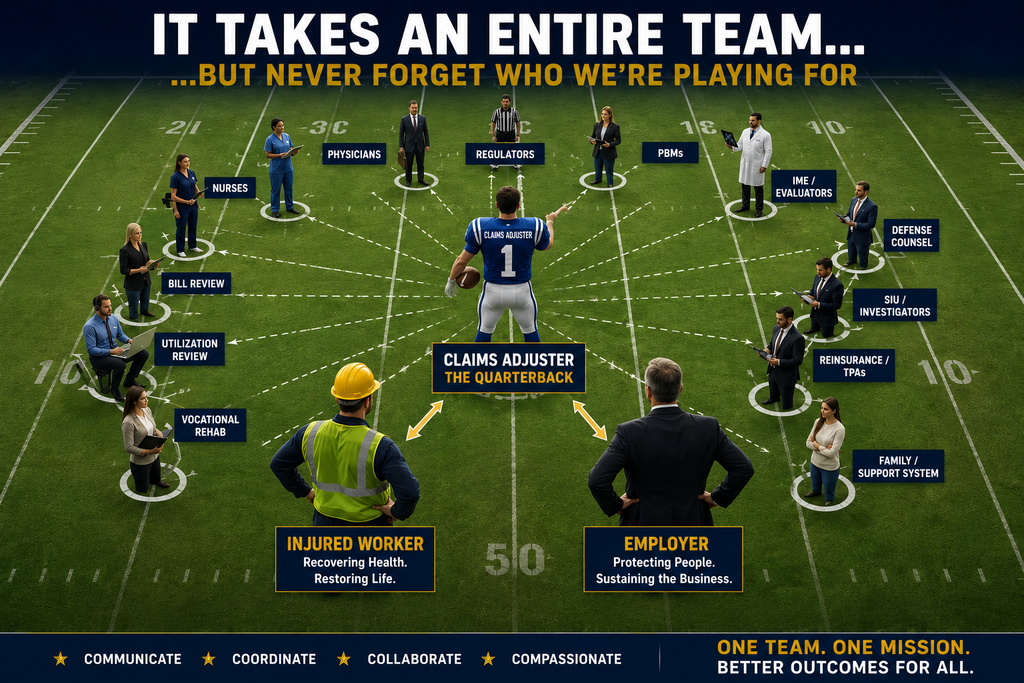
The session included a football analogy that I thought was particularly effective. The claims professional is the quarterback, coordinating all the different players (the attorneys, the providers, the case managers, etc.) making sure the right person is involved at the right time. Everyone has a role, but sometimes we lose sight of the bigger picture. We forget how all of those roles fit together, and we fail to respect the consequences if someone drops the ball.
So, what’s the play? The play isn’t simply to close the claim. The play is to help the injured worker recover.
And that led to one of the most important points of the presentation for me.
The goal isn’t simply to return to work; the goal is to return to life.
Of course, returning to work is important. But an injured worker also wants to get back to their family, their community, their activities and the things that make their life their own. The panel made the point that if we focus on returning someone to function, returning to work becomes part of that recovery. The distinction is subtle but screams loudly of importance.
The presentation also brought communication into the conversation. They discussed the importance of meaningful first contact with an injured worker within 24 hours, not simply leaving a voicemail to complete the task. They also emphasized how the employer’s response in those first few minutes after an injury can set the tone for everything that follows.
That makes sense when you put yourself in the injured worker’s position. Step into your imagination with me.
You have been hurt at work. You don’t know what happens next. You may be worried about your health, your paycheck and your family. Then someone from an insurance company or third-party administrator calls, and you don’t know who they are or whether they are calling to help you or challenge you.
An adjuster’s communication in that moment isn’t just a claims function. That action is a vital component of the recovery process and leaves a first impression. When the conversation ends, my hope is that the adjuster is beaming with pride for a job well done.
The panel also talked about the role of family members and the impact an injury can have beyond the person who was hurt. That was another good reminder that we aren’t really dealing with a claim. We are dealing with a person whose life, and often whose family’s life, has been disrupted.
I respect how easy it is to get caught up in the mechanics of the workers’ compensation process. There will always be another claim to manage, another regulation to interpret, another medical issue to address and another deadline to meet.
But occasionally, we need to step back and look at the whole field, read the defense, identify the barriers, and call the correct play.
Why are we here? What are we trying to accomplish? And are all the pieces of our complicated system working to help the injured worker get back to life while providing the employer with the protection of the Grand Bargain?
We may have built a much bigger and more complicated system around that idea, but perhaps we shouldn’t let the complexity obscure the purpose.
That was my biggest takeaway from the session.