
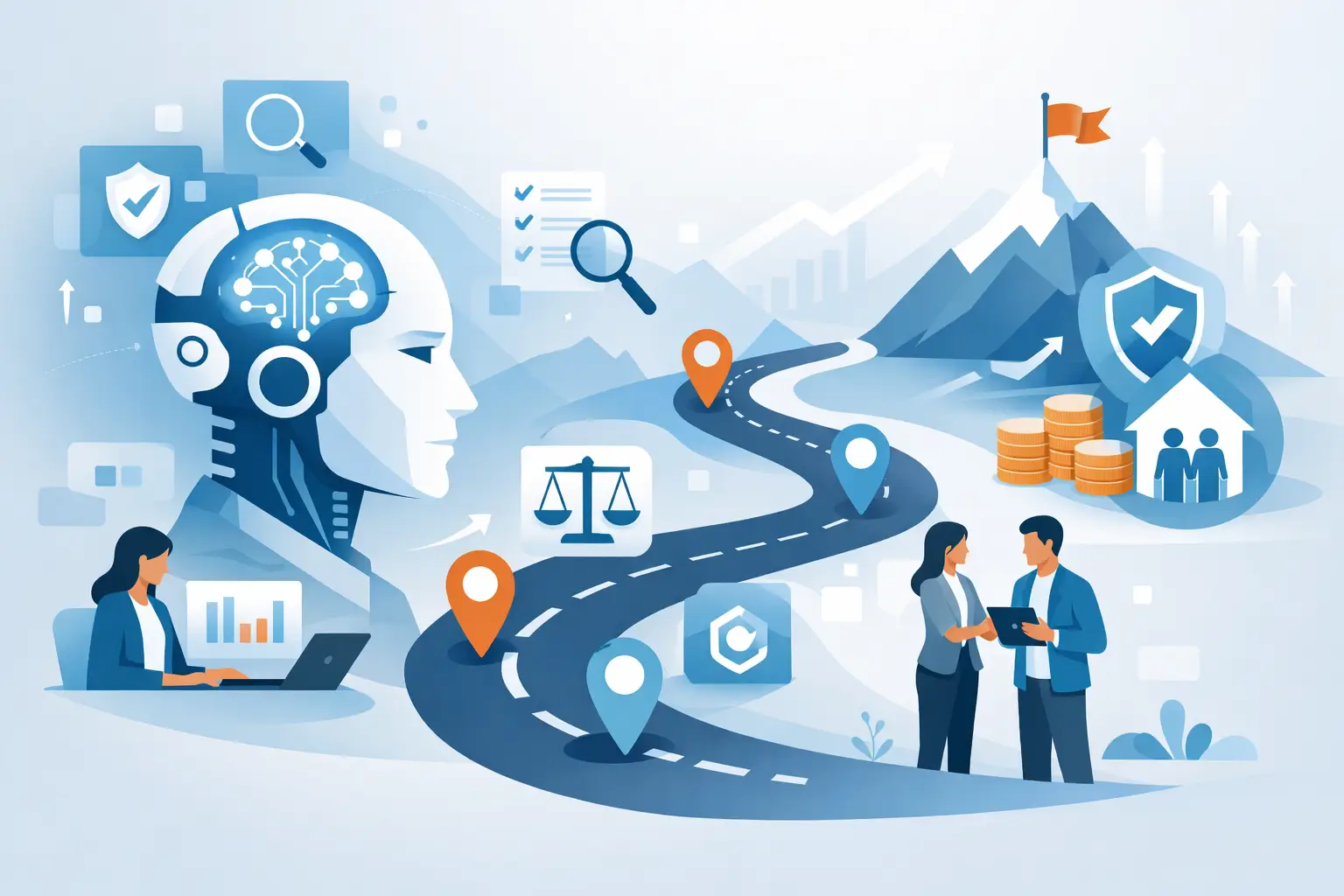
A claims professional can now summarize a medical record, draft a claimant communication, identify reserve anomalies, and surface return-to-work barriers in minutes. That speed has real value, but it also raises a more consequential question: does the user have the judgment to verify what the tool produces? An effective AI claims skills roadmap answers that question by developing capability in stages, rather than treating artificial intelligence as a software rollout or a one-time compliance course.
For workers’ compensation organizations, the objective is not simply higher adoption. It is better claim decisions, clearer communication, appropriate escalation, stronger compliance controls, and recovery experiences that preserve the dignity of injured workers. AI can support those outcomes. It cannot independently carry the professional responsibility behind them.
Why AI changes the claims competency model
Claims work is already a high-judgment discipline. Adjusters and case managers interpret incomplete information, coordinate multiple stakeholders, apply jurisdiction-specific requirements, manage sensitive medical and employment details, and communicate with people navigating an injury that may have disrupted their income, identity, and daily life.
AI changes the pace and volume of that work. It can organize information, generate first drafts, detect patterns, and reduce repetitive administrative effort. Yet it can also produce plausible but inaccurate statements, reinforce flawed historical patterns, omit critical context, or expose sensitive data when used without appropriate controls. A polished output is not the same as a defensible decision.
This is why technical platform training alone is insufficient. Organizations need a competency model that combines AI literacy with claims expertise, privacy awareness, communication skill, and whole-person recovery thinking. The professional must know what to ask an AI system, what to challenge, what not to enter, and when a human conversation is the only appropriate next step.
The AI claims skills roadmap: build capability in four levels
A useful roadmap is role-specific and progressive. A frontline adjuster, a nurse case manager, a supervisor, and a claims executive will not use AI in identical ways, nor should they be measured by the same standard. Still, the development sequence should be consistent across the enterprise.
Level 1: Establish AI literacy and responsible-use boundaries
The first level is not about advanced prompting. It is about informed use. Claims professionals should understand, in practical terms, how generative AI differs from rules-based automation and predictive models. They need to recognize that an AI-generated answer may be incomplete or incorrect, even when it sounds confident.
Training at this stage should define approved tools, prohibited uses, escalation protocols, documentation expectations, and data-handling requirements. Workers’ compensation files may include protected health information, personally identifiable information, employment records, legal strategy, and sensitive claimant narratives. Employees must know whether a tool is approved for that data type before entering a prompt, not after an incident occurs.
This level should also establish a foundational rule: AI may assist with work, but it does not assume accountability for claim handling decisions. The licensed or designated professional remains responsible for the accuracy, fairness, and regulatory appropriateness of the work product.
Level 2: Apply AI to defined, low-risk workflow tasks
Once guardrails are understood, employees can begin using AI for repeatable tasks with clear human review. Appropriate starting applications may include summarizing non-sensitive approved content, organizing questions for a stakeholder call, drafting a communication for review, converting process notes into a checklist, or identifying themes in approved training materials.
The key word is review. A generated claimant letter, for example, should be assessed for accuracy, tone, jurisdictional requirements, plain-language clarity, and the possibility that its wording could create confusion or distrust. Communication is not merely an administrative artifact. In claims, it can influence attorney involvement, treatment engagement, employer cooperation, and the injured worker’s confidence in the process.
At this stage, managers should not measure success solely by minutes saved. They should evaluate rework rates, error rates, quality assurance findings, employee confidence, and whether the workflow actually improves the claimant and employer experience. Faster work that produces more corrections is not efficiency.
Level 3: Strengthen critical review and decision support skills
The third level is where AI use becomes more valuable and more demanding. Professionals learn to use AI-generated material as decision support while testing it against the actual claim file, policy language, applicable regulations, medical evidence, and their own professional judgment.
Consider a tool that identifies delayed return-to-work risk. The output may flag missed appointments, extended work restrictions, or gaps in employer contact. Those signals are useful, but they do not explain the full circumstance. Is the worker facing transportation barriers? Has the employer offered suitable modified duty? Is the treating provider responding to requests? Has unclear communication created unnecessary anxiety or resistance?
The strongest claims professionals use AI to identify where they should look more closely, then bring curiosity, empathy, and technical knowledge to the next action. They do not allow a risk score to become a substitute for understanding a person or a file.
This level should include verification methods. Staff need a disciplined way to compare outputs against source documentation, identify unsupported conclusions, separate facts from suggestions, and record the human rationale for material decisions. Supervisors need calibration skills so that quality reviews are consistent across teams rather than dependent on individual comfort with technology.
Level 4: Lead AI-enabled operations with governance and measurement
At the enterprise level, AI competency becomes an operating model. Claims leaders must determine which problems warrant AI support, which processes require human-only handling, how vendors are evaluated, and how performance will be monitored after implementation.
This work requires more than selecting a platform. It requires governance across claims, legal, compliance, information security, operations, clinical resources, and training. The organization should establish who can approve use cases, who investigates unexpected outputs, how data access is controlled, and how changes to a model or workflow are communicated to affected teams.
Leaders should also define outcome measures before deployment. Depending on the use case, those measures may include cycle time, adjuster workload, documentation quality, escalation accuracy, return-to-work coordination, litigation trends, complaint patterns, and claimant communication quality. The appropriate metric depends on the process. A tool designed to improve note summarization should not be credited with reducing claim cost unless the organization can show a credible connection.
Human skills become more valuable, not less
There is a temptation to frame AI as a replacement for soft skills. In workers’ compensation, the opposite is more likely to be true. As administrative tasks become faster, the differentiating value of a claims professional increasingly rests on the work a system cannot perform responsibly: setting expectations, hearing what is not being said, resolving conflict, building trust, and coordinating a recovery plan across human stakeholders.
An injured worker who receives an accurate but impersonal automated message may still feel abandoned. An employer may receive a well-organized case summary yet remain unclear about transitional duty options. A nurse case manager may have excellent clinical data but need empathy and influence to engage a worker who is fearful about treatment or return to work.
That is why AI education should be integrated into, not separated from, communication and whole-person recovery training. Better prompts and better workflows matter. So do respectful conversations, realistic expectation-setting, and the ability to identify barriers that are social, emotional, occupational, or clinical rather than strictly procedural.
How to implement the roadmap without creating training theater
Organizations often begin with a broad AI awareness session, then leave employees to determine how the information applies to their roles. That approach creates uneven adoption and unnecessary risk. A stronger implementation begins with a claims workflow assessment: identify repetitive work, decision points, sensitive data exposures, frequent quality issues, and moments where better communication could change the trajectory of a claim.
From there, map training to job responsibilities. Frontline staff need practical use cases, safe prompting habits, and review discipline. Supervisors need quality calibration and coaching methods. Compliance and operational leaders need governance fluency. Executives need enough understanding to ask sound questions about risk, value, vendor claims, and measurement.
Credentialed learning pathways can help turn this from an informal initiative into a professional standard. WorkCompCollege’s education model is built for this kind of workforce development, connecting technical claims competency with communication, empathy, and operational performance. The goal is not to make every employee an AI engineer. It is to make every appropriate user a more capable, accountable claims professional.
AI will continue to change the claims environment, but the central question will remain familiar: did the next action move the injured worker, employer, and claim toward a better outcome? Build skills around that standard, and technology becomes a disciplined support for recovery rather than another source of operational noise.