WorkCompCollege – Workers' Compensation Certifications

Author: mpew

  • The Jobs Are Shrinking, But the Need for People Isn’t

    Here is a statistic that seems to contradict itself.

    The U.S. Bureau of Labor Statistics projects employment for claims adjusters, appraisers, examiners, and investigators will decline 6% over the next decade. Yet BLS also projects approximately 21,600 job openings every year. Neither one cancels out the other.

    Note that the BLS numbers include all insurance claims professionals, not just workers’ compensation. But the broader workforce dynamics should sound very familiar.

    BLS estimates there were approximately 389,700 people working in these occupations in 2025. By 2035, that number is projected to decline by about 21,800 positions.

    So where do 21,600 openings every year come from?

    BLS provides the answer. All those projected openings are expected to result from people transferring to other occupations or leaving the workforce, including retirement.

    That means we are facing a future where we need to continually replace an enormous amount of experience walking out or through another door.

    The numbers become more interesting when you put them beside workers’ compensation-specific research.

    The 2024 Workers’ Comp Industry Insights Survey from Healthesystems and Risk & Insurance surveyed 500 industry stakeholders. Half of the respondents identified workforce recruiting, retention, and succession as a major industry challenge. The report included a comment that should sound familiar: “… adjuster turnover, caseloads are too high. So many things fall through the cracks.” When experienced people leave, the remaining people inherit more work. That higher workload creates stress. That stress contributes to burnout. Burnout contributes to turnover, which further reduces the workforce and starts the cycle over again.

    There is some encouraging news, though.

    The Jacobson Group and Aon’s Q3 2026 U.S. Insurance Labor Market Study found that 89% of insurance organizations surveyed plan to either increase or maintain their staff size during the next 12 months. About half expect to increase staff. Jeffrey Blair of The Jacobson Group said many organizations appear to be hiring to backfill key positions and bring in new talent rather than simply hiring for growth.

    AI is increasingly changing the claims process. AI already summarizes voluminous medical records, assists with documentation, and identifies risks faster and more consistently than humans.  It doesn’t take much creativity to identify other uses of AI. Just a look at the mundane or overly complicated tasks still waiting to be automated. If you aren’t careful, you might assume that technology can fill the gap of missing adjusters.

    However, Milliman’s 2024 examination of claims department challenges made an important distinction. Its authors described AI as a way to complement the expertise of claims professionals, not replace it. AI processes large amounts of information so people can focus on the issues that most need their attention. It frees humans to do uniquely human things, like show empathy and take context into account. Today’s adjuster is managing information completely differently than their predecessors. They’re also managing more information than ever before. Technology can assist.

    But at the end of the day, somebody still needs to talk with the injured worker who is unsure whether they will work again. Somebody must recognize that a straightforward claim isn’t progressing the way it should. Somebody must communicate with the employer, clinician, attorney, nurse case manager, and a multitude of specialized service providers. Somebody must make decisions when the answer isn’t obvious.

    Technology can give that person better information, but it doesn’t automatically give them wisdom.

    So where do the next great adjusters come from?

    Workers’ compensation is an unusual profession because very few kids grow up saying, “I want to be a workers’ compensation claims adjuster.” This industry is filled mostly with people who happened into their role, choosing it without necessarily choosing it. That’s great for the ones who found us, but hope is not a strategy when trying to staff properly.

    The good news is that, once you’re here, you’re hooked. There are many disciplines involved in the role of a claims adjuster. Insurance, medicine, law, communication, negotiation, data, finance, return to work, risk management, human behavior, safety, technology, the list is endless. A claims adjuster combines all those unique vantage points into a single purpose: helping someone navigate what may be one of the most difficult periods of their life while fulfilling an obligation to the employer and the workers’ compensation system.

    Recruitment to a non-destination is the first part of the challenge. The other part, when they arrive, is how to prepare them. Experience doesn’t transfer through osmosis.

    Rising Medical Solutions’ 2023 Workers’ Compensation Benchmarking Study surveyed more than 1,300 frontline claims professionals. It found 72% of organizations provided formal training for new claims hires with little or no experience. The same study found that 87% of frontline claims professionals received ongoing skills training and development. Yet fewer than half strongly agreed that they received enough applicable ongoing training and development to effectively do their jobs. Rising’s research points to communication, active listening, critical thinking, and empathy as soft skills needed to excel in this role. Interestingly, only 38% reported receiving empathy training.

    The study also found that only 54% of organizations offered a formal career path with growth opportunities for claims staff. That is consistent with what I wrote about Gen Z (“Gen Z Isn’t Looking for the Exit. They’re Looking for the Ladder.”)

    If we need thousands of new people over the coming decade, recruiting them into an entry-level job isn’t enough. We need to show them a career.

    For years, I’ve heard variations of the same concern: We’re going to have an adjuster shortage.

    Based on everything I’ve shared thus far, I think that description may be incomplete.

    What is more important is the experience shortage. You can hire a person, but you cannot instantly hire 25 years of judgment. When a veteran claims professional retires, we don’t simply lose one person from the organizational chart. We potentially lose thousands of accumulated decisions, conversations, mistakes, lessons, and pattern recognitions:

    • The claim that looked ordinary but wasn’t
    • The physician who needed a phone call instead of another form
    • The injured worker whose anger was really fear
    • The employer who needed coaching on return to work
    • The little warning sign that an experienced adjuster noticed because she had seen it 100 times before

    AI can preserve some institutional knowledge, but organizations still must intentionally transfer human knowledge. That means mentoring, structured onboarding, and professional development. That is the exact gap we built WorkCompCollege.com to close. It means giving newer adjusters progressively more complicated situations while experienced professionals are still around to help them understand why a decision was made, not merely what decision was made. It means creating a learning culture before necessity creates a staffing crisis.

    Retirements, burnout, and automation are here. But that creates an opportunity – actually … 21,600 opportunities – to find talented people willing to learn and to help others.

    This isn’t a dying profession, just one that is going through a unique period of metamorphosis. The organizations and people who seize the opportunity will be the ones still here in a decade. The future of claims may require fewer people doing yesterday’s work, but it also requires a lot of well-trained people capable of doing tomorrow’s work.

  • The True Cost of an Untrained Adjuster: A Number CFOs Need Now, Not Later

    A question I put to CFOs and VPs of Claims: what does it cost your organization when an adjuster handles a claim without the clinical and procedural grounding to do it well?

    Most cannot answer with a number. They can describe the symptoms. Reserves that drift. Claims that stay open longer than they should. Files that escalate to litigation for reasons nobody can quite explain after the fact. What they usually cannot do is connect that symptom to a dollar figure they would defend in front of a board.

    That gap matters more this year than it did just a few years ago. And the reason is demographic, not theoretical. The insurance sector is projected to lose roughly 400,000 professionals to retirement between 2021 and 2026, a wave that falls heavily on senior claims staff. This issue served as one of the founding plank for the creation of WorkCompCollege.com. Every organization I work with is backfilling experienced adjusters with newer ones faster than usual. The industry is not just managing a training problem. It is managing a training problem on a compressed timeline, with less institutional knowledge left to lean on while it happens.

    Separate the symptom from the finding

    The symptom is a feeling: “our newer adjusters just need more time.” The objective finding is different. It shows up in claim duration, reopen rates, and litigation frequency, and it is measurable well before an adjuster’s third or fourth year on the job.

    A published case study from a self-insured workers’ compensation fund tracked what happened when a third-party administrator restructured its adjuster caseloads and reinforced early-file discipline over a three-year period. As caseloads dropped and structured file review improved, the accident-year closure rate rose from 28% to 49%, a 75% improvement; and the fund realized more than $1,400 in savings per closed claim compared to the prior cost baseline. Scaled across 100 files, which is over $140,000 in avoided cost, without a single change to benefit levels or medical fee schedules (Kern, “The Effects of Adjuster Case Load Size on File Closure Rates, Cost per Closed Claim and Ultimate Claim Cost,” Workers’ Comp News, 1997).

    That study is not about training curricula. It is about what happens when adjusters are given the structure, time, and grounding to do the job correctly from day one. Training is how you build that discipline into a newer adjuster’s file handling before caseload pressure erodes it.

    Where the mechanism actually works

    An undertrained adjuster does not cost money because of one dramatic error. The cost accumulates through three quieter mechanisms; each tied to a specific point in the claim lifecycle.

    The first is timing. Research from the Workers Compensation Research Institute found that claims receiving resource-intensive medical care after the first twelve months are 35 times more likely to become high-cost claims, compared to 5.7 times more likely when that same care is delivered within the first four months. An adjuster who cannot recognize the clinical markers that call for early intervention will not act early. The claim drifts into the high-cost tier by default, not by necessity.

    The second is duration. NCCI’s most recent annual review put average lost workdays at 80, up more than seven days over five years, with medical and indemnity severity each rising 6 percent in 2024. Duration control is a trained skill: knowing when a claim should be closing and recognizing when it is not.

    The third is scope. An adjuster untrained in mechanism-based clinical reasoning tends to accept whatever diagnosis arrives on the desk, whether or not it is supported by the mechanism of injury or objective findings. Degenerative findings get treated as compensable. Unsupported diagnoses go unchallenged. Scope creeps outward, and every dollar of that creep sits on your loss run permanently.

    A number your CFO can defend

    You do not need a single peer-reviewed study proving “trained adjusters save $X.” No such study exists, and any consultant who hands you one should be questioned. What you can build, defensibly, is a chain of components your own data will support.

    Start with your average cost per closed claim at a given closure benchmark, the point in the claim’s life where roughly half your open claims are closed. Compare that figure for claims handled by adjusters with under two years of experience against claims handled by your most tenured staff. The gap between those two numbers, multiplied by your annual volume of new lost-time claims, is your exposure. It will not be a footnote. In organizations I have worked with, it is usually the single largest correctable line item in the claims budget that nobody has calculated.

    What does this mean for your training calendar?

    If the retirement cliff is filling your claims floor with newer adjusters faster than your prior training cadence assumed, your training calendar needs to move at the same speed. Waiting for a new adjuster’s second or third year to close the competency gap is waiting through the exact window where the highest-cost claims are being set in motion.

    The fix is not more hours of training. It is training that targets the three mechanisms above: clinical timing recognition, duration benchmarks, and mechanism-based scope discipline, delivered early enough in an adjuster’s tenure to change file handling before habits set.

    If you want to see how organizations are building that calendar around measurable claims outcomes rather than attendance sheets, WorkCompCollege.com has resources built specifically for claims leaders working through this exact math.

    Sources

    • Bureau of Labor Statistics retirement projections, cited via The James Allen Companies, “2026 Insurance Hiring Forecast” (2025): https://jamesallenco.com/2026-insurance-hiring-forecast/
    • Gary W. Kern, ARM, “The Effects of Adjuster Case Load Size on File Closure Rates, Cost per Closed Claim and Ultimate Claim Cost,” Workers’ Comp News, Vol. 2, Issue 4, Sept/Oct 1997, republished by RiskSavers, LLC: http://risksavers.com/claims-handling/adjuster-case-load-management-a-new-approach/
    • Workers Compensation Research Institute, “Key Factors Associated with High-Cost Claims”: https://www.wcrinet.org/news/news_info/wcri-study-identifies-key-factors-associated-with-high-cost-claims-in-workers-compensation
    • NCCI, “2025 in Sight, 2024 in Review”: https://www.ncci.com/Articles/Pages/Insights-2025-in-Sight-2024-in-Review.aspx
  • Gen Z Isn’t Looking for the Exit. They’re Looking for the Ladder.

    A new healthcare workforce study reports that 70% of Gen Z healthcare workers expect to look for a new role (inside or outside their current organization) within the next year. Only 44% of Gen Z feel “very loyal” to their current employer. Those numbers seem to confirm Gen Z stereotypes:

    • They aren’t loyal
    • They’ll leave a job at the first opportunity
    • They expect promotions too quickly
    • They don’t want to “pay their dues”

    If you’re an employer, that’s enough to make you question investing heavily in developing someone who may already have one foot out the door.

    But keep reading.

    The same research showed that 95% of Gen Z respondents said long-term job security is important. In addition, 65% said they expect to remain with one employer for at least five years.

    Huh?

    They expect to look for a new role. But they also want stability and expect to stay with one employer for years. The two findings actually don’t contradict each other. Together, they suggest how the next generation sees work, learning and loyalty.

    Maybe they don’t want to leave. Maybe they want to grow.

    The study, 2026 Healthcare Workforce Barometer, was conducted by The Harris Poll on behalf of Strategic Education, Inc. and Workforce Edge. It surveyed 1,514 full-time, patient-facing healthcare workers and 304 healthcare employers.

    Important disclaimer: This is research within the healthcare industry, not workers’ compensation. Nobody should assume their findings automatically transfer to every industry or every Gen Z employee. But I would be equally cautious about ignoring what the data is telling us. Consider it a hypothesis worth testing in our own industry and across all generations.

    Among Gen Z respondents, a strong majority felt professional development mattered: 89% said clear opportunities for advancement matter, 71% valued the speed of career progression, and 86% believed education or learning new skills would help them advance. They’re not afraid of work, but they do have clear expectations for progress in their careers.

    To paraphrase, they’re asking: If I give you the next five years of my career, who can I become while I’m here?

    That’s a fair question. Employers need an answer.

    The following important statistics come from the same report but are not specific to Gen Z employees:

    • 26% “have a great deal of trust that their employer will support their long-term career growth”
    • 23% “trust their employer a great deal to be a partner in helping them advance their career”

    Meanwhile, for employers:

    • 47% point to “a lack of opportunities for career advancement, professional development, or education opportunities as the main reasons why employees leave”

    These are the report’s exact words, and they should make every employer uncomfortable. Employers have a credibility problem with their own teams: they know development matters, but their employees aren’t convinced they’ll provide it. Eighty percent of healthcare employees say advancement matters, but only 26% trust their employer to support it. That 54-point gap is worth paying attention to.

    Jill Anelli, Tanner Health’s senior vice president and chief human resources officer, told HealthLeaders, “People stay when they know they have a future in that organization.”

    Retention isn’t simply about convincing someone not to quit. It is giving them a reason to stay.

    A 24-year-old entering our industry today doesn’t just want to learn how to do the job. They want to know where it can lead and how far they can go.

    For instance, someone may enter workers’ compensation as a trainee claims adjuster, but what’s next?

    • Senior adjuster?
    • Catastrophic claims specialist?
    • Supervisor?
    • Risk manager?
    • Nurse case manager with the right credentials?
    • Operations leader?
    • Compliance specialist?
    • Executive?

    One of my favorite cartoons that I’ve used often in presentations on this subject asks two questions:

    What if I train them and they leave? Developing someone who leaves can feel like an investment made for somebody else’s benefit.

    What if you don’t train them and they stay? You now have an under-equipped employee on the team, and you’re the reason.

    The survey found that 75% of healthcare employees are interested in continuing their education, and 81% would be interested in an employer-sponsored program. Yet only 48% of healthcare employers have a comprehensive workforce education strategy.

    Talk about a disconnect.

    Taking all of this into account, imagine interviewing a talented 25-year-old and being able to explain not merely the job you’re offering, but the education, certifications, mentoring and career pathways that can follow it. Now you’re not just offering employment, but a future. As one of the report’s section headers clearly states, “Purpose gets people into healthcare. Growth keeps them invested.”

    A certificate sitting on someone’s wall is nice. Being better equipped to have a difficult conversation with an injured worker matters more. Understanding medical issues well enough to ask better questions matters more. Learning leadership skills that prepare someone to mentor the next generation matters more.

    Education becomes professional development when employees can connect what they’re learning to what they can do, and what they can do to who they can become. Not education for education’s sake, but education that changes behavior, develops people, and creates possibilities.

    Here’s the takeaway for two potential readers of this blog:

    Employers: Resist interpreting Gen Z’s appetite for advancement as impatience. Instead, ask yourself whether you have shown them a future worth staying for.

    • Have you identified the skills they’ll need to reach their potential?
    • Are you providing education, coaching and mentorship to help them develop those skills?
    • Do your youngest employees know what opportunities could exist two, five or ten years from now?

    This week: pick one entry-level role, map its next two steps, and share the map with the person who holds it.

    Gen Z professionals: If your employer invests in your development, invest in it too. Be curious, find mentors, ask questions. That approach has defined my career since 1980. Professional development isn’t something an employer does to you. It’s something you do together.

    Whichever reader you are, here’s the good news: 86% of Gen Z healthcare workers believe education and new skills will help them advance, and 80% of all healthcare workers say clear opportunities for advancement matter to them.

    They believe they can advance. They want to learn. They want to develop. They want to see what’s next.

    The data is clear about what Gen Z wants, and just as clear about what many employers haven’t built. Every year that we wait, the people we most need to keep are deciding whether we mean it.

    Instead of hoping they’ll stay, show them what their next five years look like. If you want help building the education that connects one step to the next, start a conversation about custom training. Gen Z doesn’t need convincing that growth matters. We do.

  • Lattie Taught Me to Let Go. Harry Trotter is Teaching Me to Wait.

    I felt the calling to return the blog to my horses.  So, for this week, nostalgia wins!

    My horse trainer and I have spent countless hours since Lattie passed in April pounding the pavement in search of Harry Trotter’s next best friend. I use “best friend” a little tongue-in-cheek because Lattie was never particularly fond of Harry. Harry, for his part, was perfectly willing to be friends. Their relationship was, at best, a one-sided friendship that Lattie reluctantly tolerated.

    What I’m learning through the shopping adventure is that finding the right horse is a long, arduous process. I could have another horse in our pasture tomorrow. It wouldn’t necessarily take a lot of effort, and it certainly wouldn’t have to cost an arm and a leg. What keeps me from taking the easy route is knowing that you get what you put into it. And when you’re talking about a 1,000-pound animal with a mind of its own, taking shortcuts can be extremely dangerous for everyone involved.

    You might be asking yourself what this has to do with workers’ compensation or leadership. My response is: everything.

    The more time I spend looking for Harry’s next pasture mate, the more I realize how remarkably similar this process is to finding the right employee.

    Just as with a job description, I had to define what I’m looking for. What characteristics does the horse need to have? What physical capacity does he need? What experience is important? And what are the things that are non-negotiable?

    Then the real search begins. Ads are posted, responses come in, and videos are scrutinized for everything from movement and training to behavior and soundness. If a prospect makes it through that first round, we hit the road to meet him in person. We watch him under saddle, looking for signs of lameness, how he moves, whether he is soft and responsive, how he handles himself and, yes, whether he has good manners. If all of that looks promising and we feel safe, we may climb aboard ourselves. And when we think we may have found the right match, there is still one more box to check: the pre-purchase veterinary exam. It is our version of a background check before making the final commitment.

    Think about how much goes into that decision. We are considering the horse’s physical ability, experience, temperament, history and behavior. But there is another consideration that may be just as important: how will this horse fit into the herd that is already there?

    It isn’t enough for me to like the horse. A chosen horse has to be right for me AND Harry. A horse can be beautiful, well-trained, experienced and physically sound and still not be the right horse for us.

    That realization made me think about how we approach people in the workplace.

    With a horse, we readily recognize the associated physical danger. If we choose poorly, someone could literally get hurt. The risk is obvious, so we tend to take the time to evaluate it carefully. We don’t skip the vet check because we’re excited about a particular horse. We don’t overlook concerning behavior because he’s pretty or because we’ve already spent a lot of time looking. We don’t say, “Well, he’s available, and we need another horse, so let’s just make it work.”

    Yet bringing the wrong person onto a team can be just as consequential, even if the impact isn’t as immediate or visible. An under-qualified employee or someone who is simply a poor fit can contribute to turnover, conflict, poor communication, low morale and lost productivity. Managers may spend enormous amounts of time compensating for the situation, while other employees absorb the additional workload and the effects on trust and culture. Eventually, good employees may decide the best solution is to leave.

    A horse may hurt you in an instant. A poor fit on a team can take months or even years for the full impact to become visible.

    And that brings me back to the herd.

    When we’re evaluating a horse, we don’t just ask, “Do I like this horse?” We also ask, “How will this horse fit with the horses already in my pasture?” Every herd has its own personalities, boundaries and relationships. Adding a new horse changes that dynamic, even when the newcomer is perfectly capable and well-trained.

    Teams are no different.

    We spend a lot of time talking about workplace culture, but how much attention do we give that culture when there is a vacant desk and work that needs to be done? The pressure to fill the position can be tremendous. Someone looks good on paper, has the right experience and can start Monday. Suddenly, the empty chair is no longer empty.

    But filling the chair and finding the right person aren’t necessarily the same thing.

    I’m not suggesting we spend six months interviewing every candidate for an open position. I’m suggesting that we pause long enough to consider the whole picture. Are we simply filling a vacancy, or are we choosing someone who will strengthen the team that is already there?

    After all, I’m willing to spend considerable time making sure the next horse in our pasture is safe, sound, level-headed and a good fit for Harry. Maybe we should bring some of that same thoughtfulness to the people we invite into our teams.

    My career has been blessed with some wonderful mentors who shared lessons I’m grateful to pay forward. One of the unexpected gifts of my horsemanship journey has been discovering many of those same leadership lessons from a completely different, yet remarkably applicable, perspective.

    Lattie taught me when to hold on and when to let go.

    Harry Trotter may be teaching me patience, composure, and perseverance.

  • Following Your Dreams

    Recently, I found myself standing in a hometown crowd watching my dear friend Wes Dearth do what he’s spent a lifetime pursuing. Wes, better known professionally as John Wesley, is a guitarist, songwriter, and one of rock’s most respected touring musicians. For the past several years, he has served as lead guitarist for Vertical Horizon, the popular 90s band known for hits such as Everything You Want, You’re a God, and Best I Ever Had.

    Over the course of his career, Wes has released several solo albums, toured internationally with Porcupine Tree, opened hundreds of shows for Marillion, and shared the stage with artists including Sister Hazel. Yet as long as I’ve known him, he’s remained remarkably humble about his success. I’ll admit I’ve always been a bit of a fan girl, getting excited whenever he tells a story about a performer I’ve followed for years. Still, what struck me that evening wasn’t his résumé or the impressive career that led him there. It was the joy. Seeing him glance toward family and friends in the crowd, I saw someone fully present in a moment he had spent years working toward.

    It got me thinking about pursuing our dreams, refusing to give up on them, and even more fundamentally, what are our dreams in the first place?

    As a professional guitarist, it might be easy to assume that touring with a successful band is the pinnacle of a career. Yet in speaking with Wes over the years, I’m certain there is much more to it than that. And I’ve learned that touring is not nearly as glamorous as we might think!  Success is rarely one destination. More often, it’s a collection of meaningful experiences along the way.

    But what about the rest of us? Those of us who aren’t standing under stage lights or performing in front of thousands of people. What are our dreams?

    Is it happiness and health? Raising children who become kind, capable adults? Building a successful business? Creating financial security? Contributing to our communities? Leaving things a little better than we found them?

    Deep stuff.

    Do we have to know exactly what our dreams are? Do they need to be lofty or life changing?

    Can we pivot?

    According to Angela Duckworth in her book, Grit, we absolutely should. In fact, she argues that perseverance is not about rigidly holding onto one specific goal forever. It’s about remaining committed to a larger purpose while being flexible about the path we take to get there. Sometimes the dream evolves because we evolve.

    When I think about my own life, I realize that I never grew up dreaming of becoming an entrepreneur. Starting a business was never on my vision board. In fact, if you had asked me years ago what I wanted to be, “CEO” would not have made the list.

    Yet somehow, that’s exactly where the journey led.

    What I did dream about, though I may not have had the words for it at the time, was making a difference. I wanted meaningful work. I wanted to build something worthwhile. I wanted to surround myself with people who could grow, thrive, and become more than they thought possible.

    Over the past twenty-plus years of building ReEmployAbility, I’ve discovered that entrepreneurship was not the dream itself. It was the vehicle that allowed me to pursue a larger vision.

    A vision for myself. A vision for the people who choose to spend a significant portion of their lives working alongside me. A vision for an industry that serves people during some of the most vulnerable moments of their lives.

    Workers’ compensation is often viewed as a business process, a claim, a transaction, or a cost. But behind every claim number is a person. Someone whose life was unexpectedly interrupted. Someone worried about their health, their family, their livelihood, and what comes next. Our industry’s responsibility extends far beyond managing claims. We have the opportunity to help people regain confidence, purpose, and a pathway forward.

    That vision is what gets me excited.

    Not because we’ve arrived, but because there is still so much opportunity to improve the experience of injured workers. To challenge conventional thinking. To create workplaces where employees feel valued and empowered. To leave our corner of the world better than we found it.

    Looking back, I can see that my dream wasn’t a title, a company, or even a career. It was impact. The business simply became the platform through which that impact could happen.

    And perhaps that’s true for many of us. Sometimes we spend so much time looking for a specific dream that we miss the larger purpose unfolding right in front of us. The destination may surprise us, but the values guiding us there often remain remarkably consistent.

    This thought led me back to a book I was given years ago, Mother Teresa’s Prescription, where she talks about doing one small thing to make a difference.

    One small thing.

    Not changing the world overnight.

    Not becoming famous.

    Not accomplishing some grand achievement that earns applause.

    Just one small thing.

    I love that concept because it takes the pressure off. Sometimes we look at our dreams and think they have to be monumental. We think we need a five-year plan, a vision board, and a perfectly mapped-out strategy. Yet some of the most meaningful accomplishments in our lives begin with a conversation, a decision, a risk, or a simple act of kindness.

    Perhaps our dreams are not always destinations. Perhaps they are directions.

    A dream might start as becoming a musician and evolve into inspiring others through music. It might start as building a career and evolve into mentoring future leaders. It might start as wanting success and end up being about significance.

    Looking back on my own life, many of the things that have brought me the greatest fulfillment were never part of a master plan. They emerged from opportunities I couldn’t have predicted and lessons I never would have chosen. Some dreams came true exactly as imagined. Others transformed into something entirely different, and better.

    What I’ve learned is that dreams don’t have expiration dates. They don’t disappear because we reach a certain age, change careers, experience setbacks, or discover new passions. They simply adapt along with us.

    Maybe the question isn’t, “Am I following my dream?”

    Maybe the better question is, “Am I moving toward what matters most to me?”

    Am I growing?

    Am I contributing?

    Am I becoming the person I want to be?

    When I stood in that crowd and watched Wes on stage that evening, I wasn’t inspired solely by his success because I wasn’t witnessing a single successful moment. I was witnessing thousands of ordinary moments that came before it. I was inspired by the evidence of that long journey. Years of practice. Faith. Sacrifice. Persistence. Countless small decisions that led to that stage.

    The same is true for each of us. Most dreams aren’t achieved in dramatic leaps. They’re built in ordinary days through consistent effort and small acts of courage.

    Soif you’re not entirely sure what your dream is today, that’s okay.

    If your dream has changed, that’s okay too.

    And if you’re still figuring it out, perhaps start with Mother Teresa’s advice. Do one small thing. Take one step. Help one person. Learn one new skill. Say yes to one opportunity.

    Those small things have a way of leading us exactly where we’re meant to go.

    And who knows? One day you may look back and realize that what seemed like a series of small steps was actually your dream unfolding all along.

  • Beyond the Sign-In Sheet: Why Most Training ROI Programs Measure the Wrong Thing

    Every training budget review starts with the same question. What did we get for the money?

    Most learning and development teams answer it with the wrong data. They report how just many adjusters attended, how they rated the session/training provided, and a completion percentage pulled from the learning management system. None of that tells the CFO whether the training changed anything that eventually shows up on a loss run.

    This is not a criticism of the people running the training programs. It is a description of how corporate training measures have worked for the better part of seven decades, and why that habit is now colliding with tighter budgets.

    The numbers on measurement are not encouraging. The Association for Talent Development’s 2026 State of the Industry report, based on 2025 data from 340 organizations, found that less than a quarter of respondents actually measure whether their training programs achieved the organizational goals for which they were built. A smaller share still measures return on investment.

    Meanwhile, average direct learning spends per employee fell from roughly $1,254 in 2024 to $846 in 2025, a drop of about a third, even as the average employee logged more training hours than the year before, 16.7 hours versus 13.7 (Association for Talent Development, 2026 State of the Industry Report). Organizations are spending less and asking employees to sit through more of it, without much evidence of what any of it produces.

    For a workers’ compensation claims organization, that gap is not just an L&D problem. It is a claims cost problem. If a training investment cannot be tied to claim duration, litigation rate, or reserve accuracy, the finance committee has no defensible reason to protect it the next time the budget gets cut.

    Symptoms Versus Findings

    The perception that training is overhead is a symptom. It shows up as skepticism at budget time and as the first line item cut when premium volume softens. The objective finding, when anyone bothers to look for it, is usually different. Training tied to measurable claim behavior tends to survive budget reviews. Training measured only by attendance does not, because nobody in the room can defend it with a number.

    A Framework, Not a Slogan

    Donald Kirkpatrick published his four-level model for training evaluation in 1959, and it remains the standard reference point in the field (Kirkpatrick Partners, “The Kirkpatrick Model”). It is worth restating, because most organizations use only the first two levels without realizing the third and fourth exist.

    Level one is reaction. Did the adjusters find the session useful and well delivered? This is what a post-training survey captures, and it is the easiest data to collect, which is exactly why most organizations stop here.

    Level two is learning. Did the adjuster actually absorb the material, measured with a pre- and post-test or a scored case exercise, not a show of hands?

    Level three is behavior. Is the adjuster applying what was taught on an actual file three or six months later? This requires a supervisor, or a file audit, to observe and document a change in practice.

    Here at WorkCompCollege.com, we have direct antidotal data demonstrating that the certifications obtained went directly to a change in professional behavior and resulted in significant improvement in claims outcomes.

    Level four is results. Did the organization’s numbers move? Claim duration, litigation rate, reopen rate, medical cost trend, reserve accuracy.

    Jack Phillips later added a fifth level, converting the level four results into a financial return: program benefit minus program cost, divided by program cost (Training Industry, “Phillips ROI Methodology”). The useful part of the Phillips method is not the formula. It is the requirement to isolate training’s effect from everything else moving at the same time, such as a shift in claim mix, adjuster tenure, or a state fee schedule change. Phillips’s answer is a control group where practical, or a documented trend comparison where it is not. Either way, the estimate has to be conservative and written down, not asserted.

    What a Claims Scorecard Looks Like

    Applying this to adjuster education does not require new software. It requires picking numbers the organization already tracks and connecting them to the training calendar before the training happens, not after someone asks for a budget justification.

    1. Claim duration by adjuster cohort, trained versus untrained, or before versus after a specific course.
    2. Litigation rate on claims handled by adjusters who completed a defined training module within the prior twelve months.
    3. Reopen rate, which often reflects premature closure driven by thin documentation rather than genuine medical resolution.
    4. Reserve accuracy, comparing initial reserve to final paid on a rolling basis.
    5. Medical cost trends on comparable injury types, segmented by whether the handling adjuster completed relevant clinical education.

    None of these requires a new system. Most claims organizations already have this data in their reporting stack. What is usually missing is the discipline to tag which adjusters received which training and when, so the numbers can be split and compared later.

    The Measurement Gap Is the Opportunity

    Because so few organizations measure past level one, a claims leader who builds even a basic level three or four scorecard has an advantage that has nothing to do with clinical sophistication.

    It is better to do bookkeeping. When the budget conversation comes, that leader has a defensible answer instead of an attendance sheet.

    This is not an argument for measuring everything. Specific training, particularly compliance refreshers, will always live at level one or two, and that is fine. The scorecard belongs to the training that is supposed to change claim outcomes, which describes most clinical and causation education.

    WorkCompCollege.com builds its curriculum around the claims outcomes adjusters and supervisors are actually accountable for. If your organization wants help mapping a training calendar to a measurement framework like the one above, that conversation is worth having before the next budget cycle, not during it.

    Sources: Association for Talent Development, 2026 State of the Industry Report (td.org). Kirkpatrick Partners, “The Kirkpatrick Model” (kirkpatrickpartners.com). Training Industry, “Phillips ROI Methodology” (trainingindustry.com).

  • Replay or Reframe

    I had a very difficult June, losing both my daughter-in-law and best friend to cancer. During that time (and since), my mind did something predictable.

    I replayed the circumstances. The extended battle, the moment, the preparation of my BFF’s eulogy / watching my son eulogize his wife, the fond memories of the past that remind me there will be no future memories to make.

    The replays only helped let something in the past occupy my present. The more I replayed them, the more power I gave it.

    Then I remembered cognitive reappraisal, a concept that psychologists have shared with me over the years in one-on-one conversations and from conference stages.

    Reframe.

    Reframing doesn’t change what happened. It changes the frame (or prism) through which we look at what happened. The facts remain the facts. Instead of asking, Why did this happen to me?, the question becomes, What can I do with where I am now?

    Instead of counting my problems, I started deliberately counting my blessings (yes, I sang that song to myself). Instead of continually looking backward, I tried to redirect myself toward the present and eventually toward the future.

    I did not pretend the difficult things didn’t happen. I simply decided they did not deserve unlimited reruns.

    How often do we make injured workers replay instead of helping them reframe?

    Think about what happens after a workplace injury. The supervisor, then HR, asks what happened. The initial medical provider asks. The nurse asks. The claims adjuster asks. The nurse case manager asks. Maybe an investigator asks. If litigation occurs, attorneys, experts, and others may eventually ask.

    Tell me what happened.

    Again. And again. And again.

    Obviously, that information is necessary. Clinicians need an understanding of the medical history. Claims professionals need to investigate the compensability of the claim. Employers need to understand how an accident occurred so they can mitigate future accidents. There are legitimate medical, legal, safety, and administrative reasons for asking questions.

    I wonder whether we sufficiently appreciate what we may also be asking the person to do: Replay one of the worst moments of their life.

    For us, it may be another claim intake.

    For them, it may be the moment the machine caught their hand, the ladder moved, the truck crossed the center line, they heard the pop in their back, they looked down and realized something was terribly wrong.

    We need the story. But perhaps we don’t need to keep making them live in it.

    What if we changed the questions? This is where reframing becomes interesting to me from a work comp perspective. After we have the facts we legitimately need, what if more of our conversations shifted from:

         What happened to you?

         to

         How are you doing today?

    Followed by:

    • What’s better than it was last week?
    • What can you do today that you couldn’t do a month ago?
    • What are you looking forward to getting back to?
    • What’s important to you outside of work?
    • What would progress look like to you?
    • What can we help you accomplish next?

    Notice what those questions do. They don’t deny the injury, minimize pain, or promise an outcome. They certainly don’t eliminate legitimate claims investigation or medical history-taking. They simply move the center of gravity. The injury becomes part of the person’s story rather than the only part of the story.

    That is a very different frame.

    We tend to measure what is wrong. Workers’ compensation is remarkably good at documenting deficits …

    • Pain is 7 out of 10 (FYI … I have not been a fan of the visual analog scale since 2003)
    • Range of motion is limited
    • MRI shows this, restrictions prohibit that
    • Employee cannot lift 20 pounds
    • Employee cannot stand longer than 30 minutes
    • Employee has not reached maximum medical improvement

    Those measurements matter.

    But imagine experiencing your recovery primarily through a system that continually catalogs everything you cannot do.

    What happens if we also start measuring what is returning?

    • I walked to the mailbox today
    • I drove for the first time
    • I slept through the night
    • I picked up my child
    • I made dinner
    • I worked four hours
    • I laughed with my coworkers
    • I went fishing
    • I had an entire afternoon when I didn’t think about my injury

    Those things may never appear in a claims system, but they are evidence of recovery. Some of our most important milestones don’t have billing codes.

    This connects directly to empathy. On September 3 I wrote about empathy not being soft, but strategic. To me, reframing is a natural extension of that idea.

    Empathy asks us to understand what an injured worker may be experiencing. Reframing asks us what we can do with that understanding.

    We cannot change the accident. We cannot un-break the bone. We cannot erase the surgery. We cannot give someone back the Tuesday morning before everything changed.

    But we can be intentional about where our interactions direct their attention next.

    • Toward the injury or toward recovery?
    • Toward everything they’ve lost or toward what they’re regaining?
    • Toward what happened or toward what happens next?

    That doesn’t require becoming someone’s therapist. It requires becoming more thoughtful about our words.

    To be clear, reframing isn’t positive thinking. Telling someone who is hurting to “look on the bright side” isn’t reframing. It could actually be perceived as dismissive, condescending, or invalidating.

    Reframing doesn’t replace reality with optimism. It expands reality.

    • Yes, this happened … and this is where we are now.
    • Yes, you still have pain … and look at the progress you’ve made.
    • Yes, your life may be different … and let’s talk about what you want that life to look like.

    Both things can be true.

    That’s what I had to (re)learn this summer. Counting my blessings didn’t dry my tears. Being present didn’t rewrite the past. Looking toward the future didn’t mean pretending everything behind me was wonderful. I just stopped giving the replay button quite so much attention. Instead, I focused on supporting both surviving spouses and my two granddaughters.

    Workers’ compensation professionals encounter people during seasons they didn’t choose.

    We cannot control how someone responds to an injury. We cannot manufacture resilience. And we should never trivialize the emotional consequences of having health, independence, income, identity, or purpose suddenly disrupted. But we can influence the environment surrounding their recovery.

    Every conversation can reinforce the injury or create a little more room for the person beyond the injury. Every question can pull someone backward or help them look forward. Every interaction can focus exclusively on what’s wrong or remind someone of what’s becoming right again.

    We will always need to ask: “What happened?”

    Maybe we just need to become equally good at asking: “What’s possible now?”

    The past deserves to be understood, but it doesn’t deserve to be lived forever. Just like my difficult June.

  • A Quarterback’s View of Workers’ Compensation

    One of the sessions I attended at the WCI Conference in Orlando was a Workers’ Compensation 101 panel featuring Judge Melissa Jones, Stuart Colburn, Mark Pew and Bob Wilson. The session covered a lot of ground, beginning with the history of workers’ compensation and eventually landing on a question that I think is worth asking ourselves today: Have we become so busy working within the system that we sometimes lose sight of what the system was designed to accomplish?

    The history was fascinating. We learned that the idea of compensating workers for workplace injuries goes back much further than most of us probably realize. The panel took us from ancient injury schedules to pirates, the Industrial Revolution, and the devastating Triangle Shirtwaist Factory fire on March 25, 1911 that was the impetus for the development of workers’ compensation in the United States.

    But the history wasn’t really the point.

    The point was that workers’ compensation evolved because there was a need to find a better way to take care of injured workers while also protecting employers from the uncertainty of civil litigation. That balance became what we know as the Grand Bargain.

    Over the years, however, we have built a very complicated industry around that original bargain.

    As the panel pointed out during the session, the people in 1911 could never have imagined a conference like WCI, with thousands of people, hundreds of exhibitors and representatives from across the country coming together to talk about workers’ compensation.

    And that complexity can create a problem of its own.

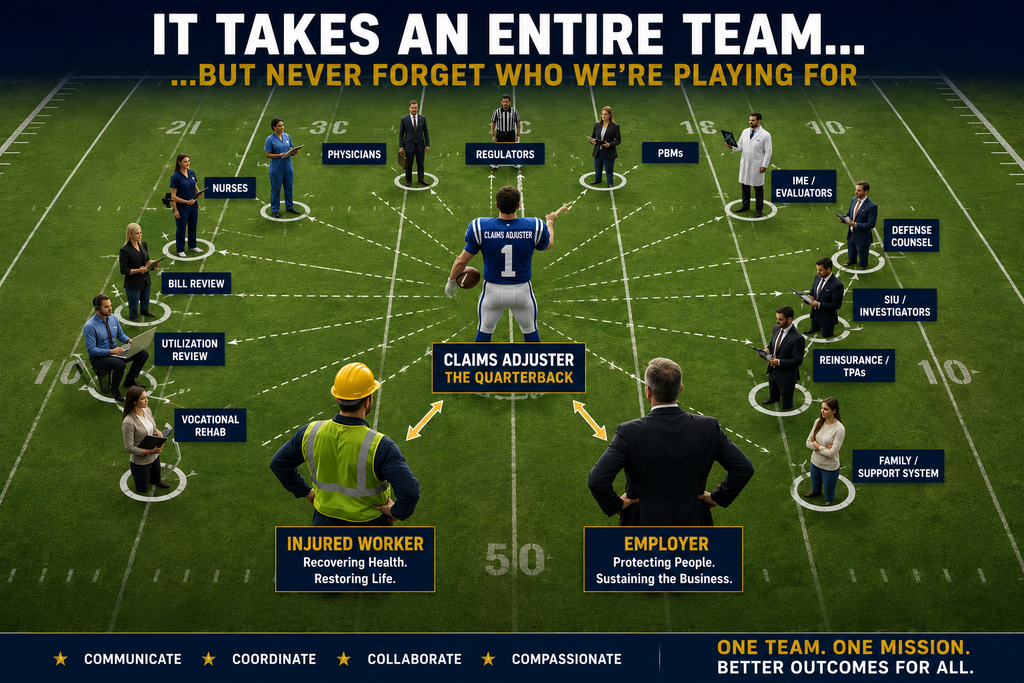
    The session included a football analogy that I thought was particularly effective. The claims professional is the quarterback, coordinating all the different players (the attorneys, the providers, the case managers, etc.) making sure the right person is involved at the right time. Everyone has a role, but sometimes we lose sight of the bigger picture. We forget how all of those roles fit together, and we fail to respect the consequences if someone drops the ball.

    So, what’s the play? The play isn’t simply to close the claim. The play is to help the injured worker recover.

    And that led to one of the most important points of the presentation for me.

    The goal isn’t simply to return to work; the goal is to return to life. 

    Of course, returning to work is important. But an injured worker also wants to get back to their family, their community, their activities and the things that make their life their own. The panel made the point that if we focus on returning someone to function, returning to work becomes part of that recovery.  The distinction is subtle but screams loudly of importance.

    The presentation also brought communication into the conversation. They discussed the importance of meaningful first contact with an injured worker within 24 hours, not simply leaving a voicemail to complete the task. They also emphasized how the employer’s response in those first few minutes after an injury can set the tone for everything that follows.

    That makes sense when you put yourself in the injured worker’s position.  Step into your imagination with me.  

    You have been hurt at work. You don’t know what happens next. You may be worried about your health, your paycheck and your family. Then someone from an insurance company or third-party administrator calls, and you don’t know who they are or whether they are calling to help you or challenge you.

    An adjuster’s communication in that moment isn’t just a claims function.  That action is a vital component of the recovery process and leaves a first impression.  When the conversation ends, my hope is that the adjuster is beaming with pride for a job well done.

    The panel also talked about the role of family members and the impact an injury can have beyond the person who was hurt. That was another good reminder that we aren’t really dealing with a claim. We are dealing with a person whose life, and often whose family’s life, has been disrupted.

    I respect how easy it is to get caught up in the mechanics of the workers’ compensation process.  There will always be another claim to manage, another regulation to interpret, another medical issue to address and another deadline to meet.

    But occasionally, we need to step back and look at the whole field, read the defense, identify the barriers, and call the correct play.

    Why are we here? What are we trying to accomplish? And are all the pieces of our complicated system working to help the injured worker get back to life while providing the employer with the protection of the Grand Bargain?

    We may have built a much bigger and more complicated system around that idea, but perhaps we shouldn’t let the complexity obscure the purpose.

    That was my biggest takeaway from the session.

  • When a Workers’ Compensation Claim Lasts 2 Years: Lessons for Adjusters

    Key Insight for Claims Professionals: For claims managers, adjusters, and risk professionals handling long-duration workers’ compensation claims, the medical timeline isn’t the only thing that determines how a claim feels to the person living through it. Communication gaps, payment delays, and unclear treatment sequencing add a second layer of strain that has nothing to do with the injury itself, and everything to do with how the claim is managed.

    How a Long Duration Workers’ Compensation Claim Affects Recovery and Trust

    Two years. That’s how long Anthony’s workers’ compensation claim lasted before he reached maximum medical improvement (MMI), a milestone indicating that a worker’s condition isn’t expected to improve significantly with additional treatment. Two years that included four rounds of physical therapy, numerous steroid injections, delayed paychecks, and one stretch of five weeks without a check at all.

    Anthony didn’t just wait to get better. He waited to find out whether he’d get better, often without a clear picture of why the process was taking the shape it did.

    “I’ve been away from my job for two years,” he said. “I’m ready to get back to work. I’m ready to get back to my normal life. I don’t understand why it’s taken so long.”

    His experience is a reminder that an extended claim timeline isn’t neutral. It compounds financial pressure, tests relationships, and wears on an injured worker in ways that have little to do with the injury itself.

    Key Insight for Claims Professionals: Organizations routinely measure claim duration, medical progress, and return-to-work outcomes. Far fewer evaluate the impact of prolonged uncertainty. Yet for many injured workers, uncertainty becomes part of the injury experience itself. When workers don’t know what comes next, why treatments are being recommended, or when they can expect progress, the passage of time becomes its own burden.

    Meet Anthony: A Delivery Driver Sidelined by a Back Injury He Didn’t Know Was Serious

    Anthony worked as a transport and delivery driver for a dairy company. When his back started hurting in November 2023, he assumed he strained it. He kept working, and his employer lightened some of his physical duties, assigning him to ride along with a trainee instead of running his usual route.

    The pain didn’t go away. When he finally saw a doctor, they discovered multiple fractures in his spine. Even the lighter version of his job, getting in and out of the truck cab, was aggravating the injury. His employer sent him home to focus on rehabilitation, and several months later, he was offered his first light-duty assignment.

    Anthony was eager to move past it. Meeting with a specialist, he was confident the answer was surgery.

    “I’m ready! I was like, ‘let’s do it today!’”

    Instead, the doctor recommended physical therapy and steroid injections first, explaining that since it wasn’t a life-or-death situation, there was time to try less invasive treatment before surgery.

    Why Treatment Plan Transparency Matters in Long-Duration Workers’ Compensation Claims

    Two years passed before surgery was approved for Anthony. He went through four separate rounds of physical therapy and numerous steroid injections that, he said, brought no noticeable relief. When approval for surgery finally came, another condition came with it: a weight-loss program he needed to complete first, with no surgery date set until he did.

    Anthony struggled to lose the weight his care team wanted, which he felt only added time to a process that was already dragging.

    “It was definitely discouraging,” he said. “I’m trying my best, but I’m feeling no improvement at all.”

    Looking back, he said he wishes the weight-loss requirement had come up earlier, before he’d already spent two years anticipating a fix that kept moving further away.

    “The recovery process has been so slow,” he said. “I understand that I need to get healthy first, but I did not expect to be away from my job this long. I’m trying to get better, but I feel like nothing has changed.”

    Key Insight: Transparency Shapes Perception: Injured workers don’t expect perfect certainty. They do expect a realistic understanding of what may lie ahead. When major treatment milestones, prerequisites, or recovery requirements are communicated late, they can feel less like planned medical decisions and more like unexpected delays.

    How Claims Adjuster Communication Gaps and Delayed Paychecks Erode Trust

    Alongside the medical delays, Anthony described a rocky start with his adjuster. Calls went unreturned. When they did speak, he said, the conversations were short. Paychecks were sometimes late, and more than once he had to escalate the issue above the adjuster to get it resolved.

    “When I eventually got paid, I was relieved, but all the stress I had to go through just to ensure I’d get my paycheck on time? It shouldn’t be that way,” he said.

    At one point, he went five weeks without a check.

    The relationship with his adjuster did improve over time, though Anthony said it was never without friction. He often felt he had to prove he was trying, providing evidence of his efforts each time he pushed back. Later in the claim, he said, the adjuster would at least call or email once a week, a real change from the early silence, even if the early friction had already taken a toll.

    His employer was a different story from the start. Anthony described his safety manager and employer as communicative throughout, checking in regularly. When light duty was first proposed, he didn’t understand why he couldn’t just stay at the warehouse; his safety manager explained he could still keep his routine and connect with people, just at a nonprofit instead.

    “My employer has been hands-on throughout my return-to-work journey, and it has made all the difference,” he said.

    Key Insight for Claims Professionals: Effective claims adjuster communication is about more than returning calls. Consistent updates, clear explanations, and proactive outreach help injured workers understand what is happening with their claim and reduce the uncertainty that often builds during long-duration recoveries.

    The Financial Impact of Long-Duration Workers’ Compensation Claims

    The length of the claim also reshaped Anthony’s finances in ways a shorter recovery wouldn’t have.

    Twenty years into his driving career, he was used to overtime pay that supported his family.  Working strictly 40 hours a week during recovery required an adjustment.

    “It’s rough now,” he said. “I’m used to making a certain amount of money to accommodate my lifestyle, my kids’ lifestyles… this has been an adjustment.”

    He said the same questions resurface every time he’s hurt on the job.

    “How long am I going to be hurt? How can I provide for my family if I’m not at work? How will I get through this? What do I need to do to get better, to get through this?”

    For injured workers, those questions often become as important as the medical questions themselves. Recovery is rarely experienced in isolation from financial responsibilities, family commitments, and concerns about future employment.

    How Transition2Work® Provided Purpose During a Long Recovery

    Anthony worked several light-duty assignments through Transition2Work, spending his final 16 months at a local nonprofit before reaching maximum medical improvement. There, he worked at the front desk, often the first-person clients interacted with.

    “I like being here, knowing that I’m helping,” he said. “You get to know these people, and I’ve gotten attached to a lot of them. I know their lives. They give me purpose, they give me reason.”

    He said he feels a responsibility to the people he’s met there that extends past his own return to work.

     “I would like to do more here, help them provide more services, help get the people the resources they need, even when I got back to work.”

    The nonprofit assignment gave Anthony something the rest of the claim hadn’t: a routine, a sense of contribution, a consistent connection to other people.

    Research from the National Council on Compensation Insurance (NCCI) has found that maintaining engagement with meaningful work and workplace connections during recovery is a key characteristic of successful return-to-work programs. Anthony’s experience at the nonprofit reflects many of those same principles.

    It didn’t erase the two years of financial strain or the frustration of a stalled treatment plan, those remained real parts of his experience. But it gave him a place to stand while he waited for the rest of the claim to move.

    What Claims Professionals Can Learn About Long-Duration Workers’ Compensation Claims

    Anthony’s claim wasn’t marked by a single dramatic failure. It was marked by accumulation. An unreturned call. A paycheck that didn’t arrive on time. A treatment requirement communicated later than expected.  Weeks and months of uncertainty.

    None of these things, on their own, would have derailed recovery. Together, over two years, they added a layer of financial and emotional strain that had little to do with his spine.

    The lesson isn’t that Anthony’s treatment plan was wrong. A doctor’s caution about trying less invasive options before surgery is standard, defensible care.  The lesson is that injured workers experience claims as a whole, not as a series of separate transactions.

    At ReEmployAbility, long-duration claims often reveal the same pattern. Workers rarely point to a single event as the source of frustration. Instead, dissatisfaction builds through uncertainty, gaps in claims adjuster communication, interruptions in income, and prolonged separation from meaningful work.

    Anthony’s experience underscores a reality claims professionals can influence. While the medical timeline isn’t always controllable, transparency, communication, payment reliability, and opportunities for productive engagement often are. In long-duration workers’ compensation claims, those factors can shape the worker’s experience as much as the treatment itself.

    Key Takeaways for Claim Professionals

    • Share the full treatment sequence up front. If a step like a weight-loss program is required before surgery, communicate it as early as possible, not after the worker has already spent years anticipating a different timeline. 
    • Treat on-time payment as a baseline expectation. A five-week gap in pay does lasting damage in trust that better communication elsewhere can’t fully repair.
    • Recognize that claim length is its own stressor. Build proactive check-ins into long-duration claims even when the medical picture hasn’t changed.
    • Introduce transitional work opportunities when medically appropriate. Meaningful work can provide structure, purpose, and social connection during prolonged recoveries.
    • Understand that first impressions matter. Communication challenges early in a claim often continue shaping worker perceptions long after service levels improve.
    • Measure the experience, not just the outcome. Medical progress and return-to-work outcomes matter, but so does how workers experience the journey between injury and recovery.
  • The First Ninety Minutes: What a Supervisor’s Training Is Actually Worth

    Ask a CFO what a claim costs and you will get a number pulled from the reserve system. Ask what a claim costs when it is reported three weeks late instead of the same day, and most CFOs cannot answer. That gap is worth closing, because the answer is large, measurable, and directly tied to something the organization controls: how well the front-line supervisor is trained.

    The data on reporting lag is not new, but it is, in my experience, underused. NCCI’s 2015 study of claim report lag, drawn from a large multistate sample, found that claims reported more than four weeks after the injury cost roughly 51% more than claims reported within 1 – 2 weeks. Attorney involvement follows the same curve. Claims reported immediately involve an attorney about 13% of the time. Claims reported after four weeks involve an attorney closer to 32% of the time. The delay itself, independent of injury severity, is predictive of both cost and litigation.

    The clinical explanation is straightforward. A worker with an untreated soft tissue injury does not heal while waiting to be believed. Inflammation persists, compensatory movement patterns set in, and by the time a claim finally reaches a clinician, the presentation is more complicated than the original mechanism would suggest. At the same time, the human explanation matters just as much. A worker who reports an injury and is met with confusion, delay, or skepticism starts building a narrative of being unsupported. By the time an attorney enters the picture, the adjuster is not managing a soft tissue strain. The adjuster is managing distrust.

    Who controls how fast a claim gets reported? Not the adjuster. The adjuster does not learn about the injury until someone tells them. The person who controls that first ninety minutes is the front-line supervisor, the person the injured worker actually talks to. Whether that supervisor knows what a reportable incident is, how to document it without making promises they cannot keep, and who to notify immediately determines whether a claim starts on time or starts late.

    This is where training stops being a line item and starts being a lever. A case study frequently cited in claims literature, conducted in a food-processing environment, found that after supervisors completed a four-hour training on communication and injury response, new workers’ compensation claims dropped approximately 47% and active lost-time claims fell about 18% over the following seven months. That is not a claims department result. That is a supervisor-training result, and it shows up on the same loss run the claims department gets credit or blame for.

    Here is where the symptoms and the findings need to be kept separate, because most organizations confuse them. The symptom is a widespread perception that supervisor training is a soft skill, something HR schedules once a year and nobody remembers by March. The objective finding is different. Reporting speed is measurable. Attorney involvement is measurable. Claim cost by report-lag bucket is measurable. None of those numbers depend on how anyone feels about the training. They depend on whether the training happened and whether it changed behavior in the first ninety minutes after an injury.

    For a risk manager building a case for training spend, this is a cleaner argument than most. It does not require faith in culture change. It requires pulling report-lag data out of the claims system, sorting claims by time-to-report, and comparing cost and litigation rate across those buckets. If the pattern in your own book matches the NCCI pattern, and in most books it does, the business case writes itself. Reserve accuracy improves when claims start on time, because the initial reserve is set on better information. Total cost of risk improves because fewer claims escalate into the cost and duration profile that late reporting predicts.

    As I have written on many occasions, training as cost containment tool is not a new idea in this space. However, reporting speed is one of the cleaner places to prove it. As noted previously, the causal chain is short. An untrained supervisor leads to a delayed report. Delayed report leads to higher costs and higher litigation rate. Trained supervisor leads to a faster report. Faster reporting leads to a claim that behaves the way the evidence-medicine predicts it should, instead of the way distrust and delay predict it will.

    Sources: NCCI, “The Relationship Between Accident Report Lag and Claim Cost in Workers Compensation Insurance,” 2015. Amaxx Workers’ Comp Blog, “How Supervisor Actions Shape Workers’ Comp Costs and Recovery,” 2026.