
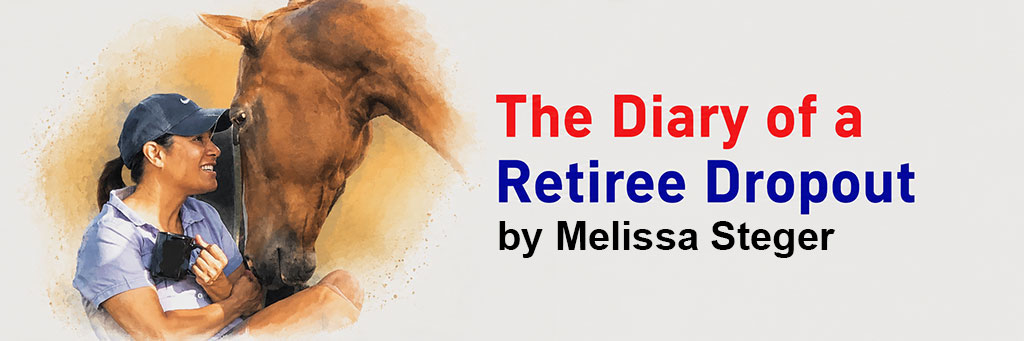
I felt the calling to return the blog to my horses. So, for this week, nostalgia wins!
My horse trainer and I have spent countless hours since Lattie passed in April pounding the pavement in search of Harry Trotter’s next best friend. I use “best friend” a little tongue-in-cheek because Lattie was never particularly fond of Harry. Harry, for his part, was perfectly willing to be friends. Their relationship was, at best, a one-sided friendship that Lattie reluctantly tolerated.
What I’m learning through the shopping adventure is that finding the right horse is a long, arduous process. I could have another horse in our pasture tomorrow. It wouldn’t necessarily take a lot of effort, and it certainly wouldn’t have to cost an arm and a leg. What keeps me from taking the easy route is knowing that you get what you put into it. And when you’re talking about a 1,000-pound animal with a mind of its own, taking shortcuts can be extremely dangerous for everyone involved.
You might be asking yourself what this has to do with workers’ compensation or leadership. My response is: everything.
The more time I spend looking for Harry’s next pasture mate, the more I realize how remarkably similar this process is to finding the right employee.
Just as with a job description, I had to define what I’m looking for. What characteristics does the horse need to have? What physical capacity does he need? What experience is important? And what are the things that are non-negotiable?
Then the real search begins. Ads are posted, responses come in, and videos are scrutinized for everything from movement and training to behavior and soundness. If a prospect makes it through that first round, we hit the road to meet him in person. We watch him under saddle, looking for signs of lameness, how he moves, whether he is soft and responsive, how he handles himself and, yes, whether he has good manners. If all of that looks promising and we feel safe, we may climb aboard ourselves. And when we think we may have found the right match, there is still one more box to check: the pre-purchase veterinary exam. It is our version of a background check before making the final commitment.
Think about how much goes into that decision. We are considering the horse’s physical ability, experience, temperament, history and behavior. But there is another consideration that may be just as important: how will this horse fit into the herd that is already there?
It isn’t enough for me to like the horse. A chosen horse has to be right for me AND Harry. A horse can be beautiful, well-trained, experienced and physically sound and still not be the right horse for us.
That realization made me think about how we approach people in the workplace.
With a horse, we readily recognize the associated physical danger. If we choose poorly, someone could literally get hurt. The risk is obvious, so we tend to take the time to evaluate it carefully. We don’t skip the vet check because we’re excited about a particular horse. We don’t overlook concerning behavior because he’s pretty or because we’ve already spent a lot of time looking. We don’t say, “Well, he’s available, and we need another horse, so let’s just make it work.”
Yet bringing the wrong person onto a team can be just as consequential, even if the impact isn’t as immediate or visible. An under-qualified employee or someone who is simply a poor fit can contribute to turnover, conflict, poor communication, low morale and lost productivity. Managers may spend enormous amounts of time compensating for the situation, while other employees absorb the additional workload and the effects on trust and culture. Eventually, good employees may decide the best solution is to leave.
A horse may hurt you in an instant. A poor fit on a team can take months or even years for the full impact to become visible.
And that brings me back to the herd.
When we’re evaluating a horse, we don’t just ask, “Do I like this horse?” We also ask, “How will this horse fit with the horses already in my pasture?” Every herd has its own personalities, boundaries and relationships. Adding a new horse changes that dynamic, even when the newcomer is perfectly capable and well-trained.
Teams are no different.
We spend a lot of time talking about workplace culture, but how much attention do we give that culture when there is a vacant desk and work that needs to be done? The pressure to fill the position can be tremendous. Someone looks good on paper, has the right experience and can start Monday. Suddenly, the empty chair is no longer empty.
But filling the chair and finding the right person aren’t necessarily the same thing.
I’m not suggesting we spend six months interviewing every candidate for an open position. I’m suggesting that we pause long enough to consider the whole picture. Are we simply filling a vacancy, or are we choosing someone who will strengthen the team that is already there?
After all, I’m willing to spend considerable time making sure the next horse in our pasture is safe, sound, level-headed and a good fit for Harry. Maybe we should bring some of that same thoughtfulness to the people we invite into our teams.
My career has been blessed with some wonderful mentors who shared lessons I’m grateful to pay forward. One of the unexpected gifts of my horsemanship journey has been discovering many of those same leadership lessons from a completely different, yet remarkably applicable, perspective.
Lattie taught me when to hold on and when to let go.
Harry Trotter may be teaching me patience, composure, and perseverance.