

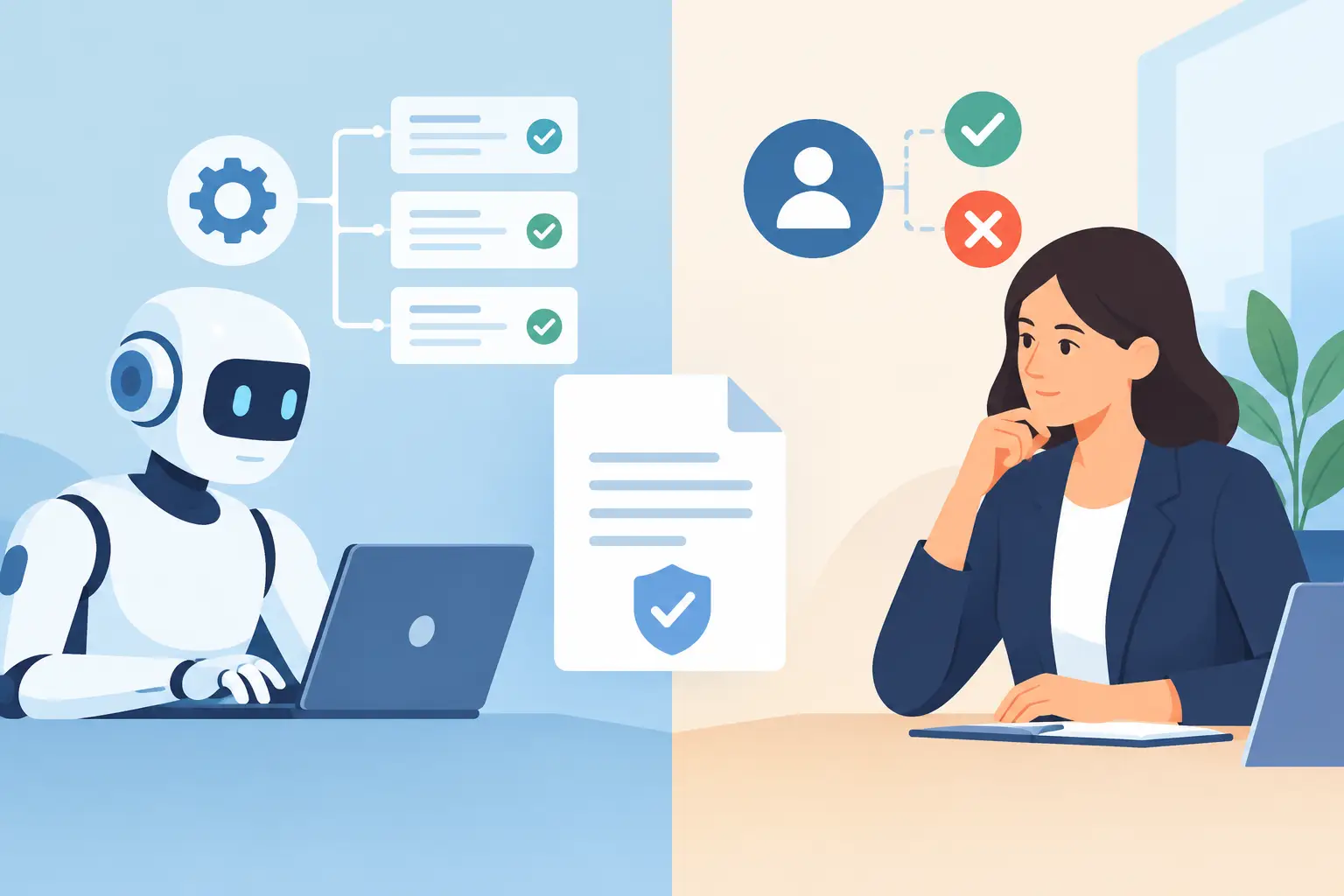
A first report of injury can be triaged in seconds. A payment can be released without a keystroke. A routine status update can be triggered automatically. Yet claims automation versus human judgment is not a contest between speed and compassion. It is an operating-model decision that determines whether technology reduces administrative friction or simply accelerates poor claims outcomes.
For workers’ compensation organizations, the stakes are unusually high. A claim is not merely a transaction moving through a workflow. It involves an injured worker’s health, income, job security, family pressures, employer relationship, medical care, and legal exposure. Automation can improve consistency and throughput. Human judgment remains necessary to recognize when a technically correct action may produce the wrong recovery outcome.
Where Claims Automation Creates Real Value
Automation is most valuable when the task is repetitive, rules-based, time-sensitive, and supported by reliable data. In workers’ compensation, that can include intake routing, diary creation, wage-data validation, form generation, payment processing, required notices, document classification, and escalation alerts.
These capabilities matter because claims professionals should not spend their highest-value hours searching for documents, re-entering data, or tracking routine deadlines. A well-designed automation program reduces avoidable administrative burden and gives adjusters, nurse case managers, and supervisors more capacity for work that requires analysis and communication.
Automation can also strengthen operational discipline. When routine triggers are consistently applied, organizations can reduce missed tasks, improve timeliness, and create a clearer audit trail. For enterprise leaders, this supports more predictable service levels, stronger compliance oversight, and better visibility into where claims are slowing down.
The benefit, however, depends on process quality. Automating an unclear intake process does not create clarity. It can scale inconsistency across a larger volume of claims. Before adding technology, organizations need to define the decisions, handoffs, ownership, and exceptions that the technology is expected to support.
The right work to automate
The strongest candidates are high-volume activities with clear inputs and repeatable business rules. Think of automation as a disciplined way to handle the predictable parts of a claim. It should reduce friction around the claim, not replace the professional responsibility to understand it.
For example, a system can identify a missing medical authorization, create a follow-up task, and notify the appropriate party. It cannot reliably determine whether the injured worker understands why the authorization matters, is having trouble accessing care, or has stopped responding because they fear losing their job.
Claims Automation Versus Human Judgment at the Decision Point
Human judgment becomes most important where the facts are incomplete, the worker’s circumstances are changing, or the consequences of a decision extend beyond a single workflow. That is common in workers’ compensation.
An adjuster may see delayed treatment, inconsistent reporting, repeated missed appointments, or a request for additional time off work. Those signals can indicate a coverage concern or a compliance issue. They can also indicate transportation barriers, low health literacy, unresolved pain, a difficult supervisor relationship, language needs, or a worker who has not received clear expectations.
A rules engine can flag the pattern. A trained professional must interpret it.
That interpretation should not be confused with intuition alone. Sound judgment combines jurisdiction-specific knowledge, compensability analysis, medical and return-to-work understanding, documentation discipline, and purposeful communication. It asks not only, “What does the file say?” but also, “What is preventing this person from moving forward?”
This is where a whole-person recovery approach changes claim handling. The goal is not to excuse every delay or override appropriate controls. The goal is to identify barriers early enough to prevent a routine issue from becoming prolonged disability, attorney involvement, employee disengagement, or an adversarial claim relationship.
The Risk of Automating the Wrong Decision
The most significant automation failures are often not technical failures. They are judgment failures embedded in a workflow.
Consider a claim in which an automated communication sequence sends a standard return-to-work message after receipt of a work-status note. The message may be timely and compliant. But if the employer has not identified modified duty, the worker has not been contacted personally, or the medical restrictions are unclear, the message can create confusion and erode trust.
The system did what it was programmed to do. The organization still failed to manage the recovery.
The same problem arises when predictive tools influence prioritization without a clear human review process. Risk scoring can help claims teams direct attention to files that may need intervention. It should not become a substitute for evaluating the quality of medical care, the worker’s experience, employer readiness, or the possibility that a biased data pattern is being treated as an objective forecast.
Leaders should be particularly cautious when automation affects benefit decisions, claim denials, medical utilization, settlement strategy, or communications with vulnerable claimants. These areas carry legal, ethical, and reputational consequences. The appropriate model is not blind approval of a system recommendation. It is documented human accountability supported by relevant information.
Build a Human-in-the-Loop Claims Model
A practical model separates execution from judgment. Technology executes defined, repeatable activities and surfaces meaningful exceptions. Professionals assess those exceptions, communicate with the people involved, and make decisions that require context.
That model requires more than a manual override button. It requires clear governance. Claims teams need to know which decisions can be automated, when a file must be escalated, who owns the escalation, and how the rationale for a decision will be documented.
Organizations should establish decision thresholds that reflect claim complexity, not just dollar values. A low-cost claim can still require immediate human attention if the injured worker is confused about treatment, the employer relationship is deteriorating, or return-to-work planning has stalled. Conversely, a stable, uncomplicated claim may benefit from highly automated service and proactive digital updates.
Training is the bridge between technology investment and performance. Adjusters and case managers need enough fluency to question an automated recommendation, recognize data limitations, and explain decisions in language an injured worker can understand. Supervisors need to evaluate whether automation is improving recovery and resolution, rather than simply increasing task completion rates.
At WorkCompCollege, this means treating empathy, expectation-setting, and communication as operational competencies. They are not soft extras added after technical training. They are capabilities that help professionals gather better information, reduce misunderstanding, support treatment engagement, and identify issues before they become expensive claim complications.
Measure what the model actually changes
A dashboard full of automation metrics can create false confidence. Cycle time, touchless processing rates, and task completion are useful, but they are incomplete measures of workers’ compensation performance.
Pair operational measures with outcomes that reflect the quality of claim handling: timely contact with injured workers, treatment adherence barriers identified, modified-duty placement, duration of disability, attorney involvement, complaint patterns, reopen rates, and variance in outcomes across claim populations. Review a sample of automated communications and decisions for clarity, accuracy, and tone.
The question is not whether the system processed the claim faster. The question is whether the claim moved forward with fewer obstacles and a better chance of sustainable recovery.
A Better Standard for Claims Performance
The future of claims operations is not fully automated or fully manual. It is more deliberate. Routine work should move quickly, accurately, and consistently through technology. Complex human situations should move promptly to professionals equipped to listen, analyze, explain, and act.
That balance will differ by jurisdiction, claim volume, workforce composition, technology maturity, and employer program design. There is no universal percentage of automation that signals success. A carrier or TPA with strong data governance and mature workflows may automate more safely than an organization still struggling with inconsistent documentation or uneven adjuster training.
The strongest claims organizations will treat automation as a capacity strategy, not a replacement strategy. They will use it to create time for earlier outreach, clearer expectations, stronger coordination, and more informed decisions.
When a workflow identifies an exception, the next step should not be another automated message by default. It should be a well-prepared professional asking the question that a system cannot: “What do you need to move forward?”