
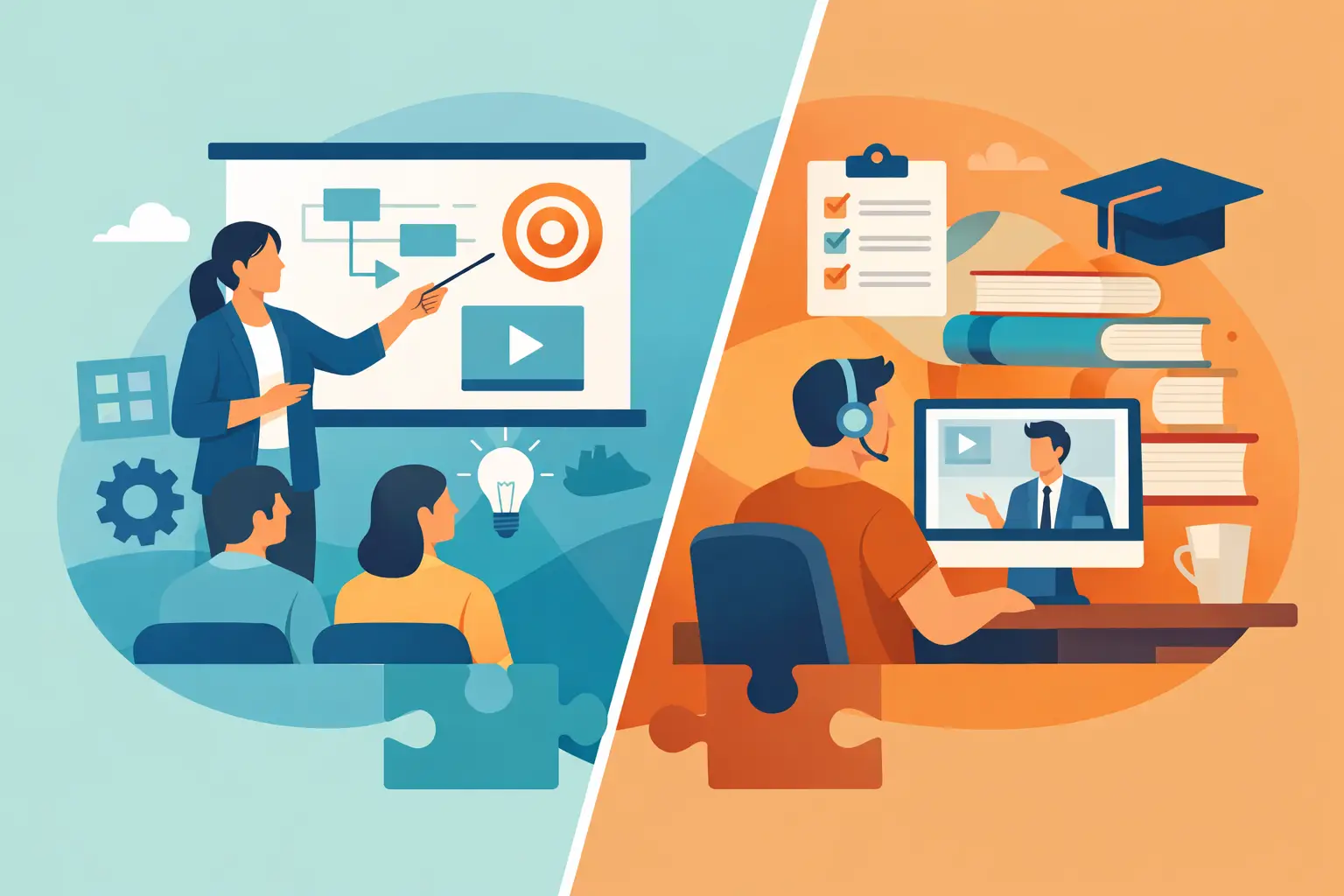
A claims professional can complete every required continuing education hour and still be unprepared for the conversation that determines whether an injured worker trusts the process or calls an attorney. That is the central distinction in custom training vs generic CE. Both have value, but they solve different problems – and confusing compliance activity with workforce capability is costly.
For workers’ compensation organizations, education is not simply an annual licensing requirement. It is an operating system for claims decisions, communication standards, medical coordination, return-to-work planning, and regulatory discipline. The right training approach should be judged by whether it changes performance where claims outcomes are won or lost.
Generic CE serves a necessary but limited purpose
Generic continuing education is designed for broad applicability. It can efficiently deliver updates on regulations, ethics, legal developments, or foundational insurance concepts to a large audience. When the need is to satisfy a state requirement, document attendance, or provide a baseline understanding of a topic, generic CE may be entirely appropriate.
The limitation is not that generic CE lacks information. The limitation is that it is rarely built around the specific claim environment in which a learner works. A nurse case manager, an indemnity adjuster, a supervisor, and a risk manager may all attend the same course, yet each faces different decisions, measures success differently, and needs different behaviors reinforced.
A broad course on communication, for example, may explain active listening. It may not address how an adjuster should set realistic expectations after a compensability dispute, explain a utilization review decision without escalating frustration, or document a difficult conversation in a manner that supports the claim file. Those details are not peripheral. They influence injured-worker engagement, treatment adherence, attorney involvement, and duration.
Generic CE also tends to be episodic. Learners complete a module, receive credit, and move on. There may be little connection to the organization’s claim philosophy, workflows, escalation protocols, quality standards, or performance data. As a result, knowledge can remain theoretical rather than becoming a consistent operating practice.
Custom training vs generic CE: the operational difference
Custom training begins with the premise that a workforce does not need more information in the abstract. It needs the right capability, delivered to the right role, at the point where that capability affects outcomes.
In workers’ compensation, that means training can be shaped around an organization’s jurisdictional footprint, claim inventory, clinical resources, communication standards, return-to-work program, litigation patterns, and service commitments. It can use scenarios that resemble the actual decisions employees make, rather than hypothetical situations that never appear in their files.
This approach creates a direct line between education and business performance. If an organization is seeing delayed return-to-work conversations, inconsistent reserve rationale, preventable complaints, or higher-than-expected attorney representation, training can target the behaviors contributing to those outcomes. The goal is not merely course completion. The goal is measurable improvement in how work is performed.
That does not mean custom training should ignore technical content. Technical excellence remains essential. Claims professionals need sound knowledge of jurisdictional rules, medical management, Medicare Secondary Payer obligations, compensability analysis, documentation, and compliance requirements. The difference is that custom education places that knowledge inside the real human and operational context of a claim.
A technically correct decision can still produce a poor outcome if it is communicated late, explained poorly, or delivered without respect. Whole-person recovery management recognizes that injured workers are not files moving through a system. They are people managing pain, uncertainty, financial pressure, work identity, family responsibilities, and concern about what happens next. Training that treats empathy, expectation-setting, and clear communication as professional competencies can improve both the worker experience and claim economics.
Where generic CE can still be the right choice
The choice is not always custom training. Organizations should avoid treating customization as a status symbol when a focused, established CE course will meet the need.
Generic CE is often a practical option when the audience needs a straightforward regulatory update, a required ethics credit, or introductory exposure to a topic outside its core responsibilities. It can also be effective for individuals building foundational knowledge before entering a more advanced certification pathway.
The issue arises when leaders expect a standardized course to solve a localized performance problem. A general module on claims professionalism will not, by itself, correct inconsistent initial contact practices across a multi-state team. A broad presentation on return to work will not create alignment among supervisors, treating providers, employers, and adjusters. In those cases, the organization needs training connected to its own process, leadership expectations, and measurement framework.
The questions leaders should ask before selecting a program
Training decisions improve when leaders begin with the operational problem, not the course catalog. The first question is simple: what must be different after this education is complete?
If the answer is “employees need CE credit,” the selection criteria may center on approved hours, topic coverage, accessibility, and completion reporting. If the answer is “we need to reduce variance in claims handling” or “our team needs to have more productive conversations with injured workers,” a different standard applies.
Leaders should then examine whether the training is role-specific. Frontline adjusters need practical tools for first contact, investigation, expectation-setting, medical coordination, and difficult conversations. Supervisors need the ability to coach those behaviors, identify quality gaps, and reinforce consistent decision-making. Executives and program leaders need visibility into adoption, performance indicators, and organizational return on investment.
The final question is whether learning can be reinforced. One-time instruction has limited power against the pressure of caseloads, changing regulations, turnover, and established habits. Strong workforce development includes onboarding, recurring education, manager reinforcement, role-based pathways, and a way to assess whether capability is improving over time.
What effective custom education should include
Custom training is not simply adding a company logo to a standard slide deck. Meaningful customization begins with discovery: understanding the learner population, organizational objectives, jurisdictional realities, current workflows, and areas of claim friction.
The curriculum should then connect technical requirements to observable practices. For example, education on communication should specify how and when initial contact occurs, how benefits and next steps are explained, how concerns are documented, and when a matter should be escalated. Education on return to work should address employer engagement, functional capacity, modified duty coordination, and the language that helps an injured worker see a realistic path forward.
Assessment matters as well. Completion data alone tells leaders who attended. It does not show whether participants can apply the material. Scenario-based exercises, knowledge checks, supervisory coaching tools, and performance reviews provide stronger evidence that the training is reaching the claim file.
For enterprise teams, scalability is equally important. A custom program must deliver a consistent standard across offices, roles, and new-hire cohorts without becoming difficult to maintain. A structured learning ecosystem can support this balance by combining foundational content, role-specific modules, certification pathways, and organization-specific application.
WorkCompCollege approaches this challenge through workers’ compensation education built around the Whole Person Recovery Method™, connecting formal technical training with communication, empathy, and recovery-focused claims practices. That connection matters because better claims handling is not achieved by soft skills alone or technical knowledge alone. It requires professionals who can apply both under real claim conditions.
Measure the result, not just the attendance
The most useful training metrics extend beyond registrations, course completions, and satisfaction scores. Those measures are helpful, but they are leading indicators of participation, not proof of organizational improvement.
Organizations should identify the claim outcomes and process measures most relevant to the original training objective. Depending on the program, that may include timeliness of initial contact, documentation quality, return-to-work engagement, complaint trends, attorney involvement, cycle time, supervisory audit findings, or consistency in required compliance steps.
Not every result can be attributed to training alone. Staffing levels, claim mix, jurisdictional changes, provider access, and economic conditions all affect performance. Still, organizations can establish a baseline, define expected behavior changes, and monitor whether results move in the intended direction. This makes education a managed investment rather than an administrative expense.
The strongest programs also create feedback loops. If quality audits reveal that learners understand a concept but struggle to apply it in complex files, the curriculum can be adjusted. If managers identify recurring communication failures, those situations can become new case studies. Custom education becomes more valuable when it evolves with the organization’s risks and opportunities.
Build capability where claims become personal
The real test of any workers’ compensation education is not whether the material was accurate, although accuracy is nonnegotiable. It is whether a professional handles the next difficult conversation, treatment delay, return-to-work discussion, or compliance decision with greater clarity, competence, and respect.
Generic CE can keep professionals current. Custom training can help an organization become consistently better. When education reflects the work people actually do and the recovery outcomes they are responsible for, it becomes one of the most practical ways to improve both the human experience of a claim and the financial performance behind it.