

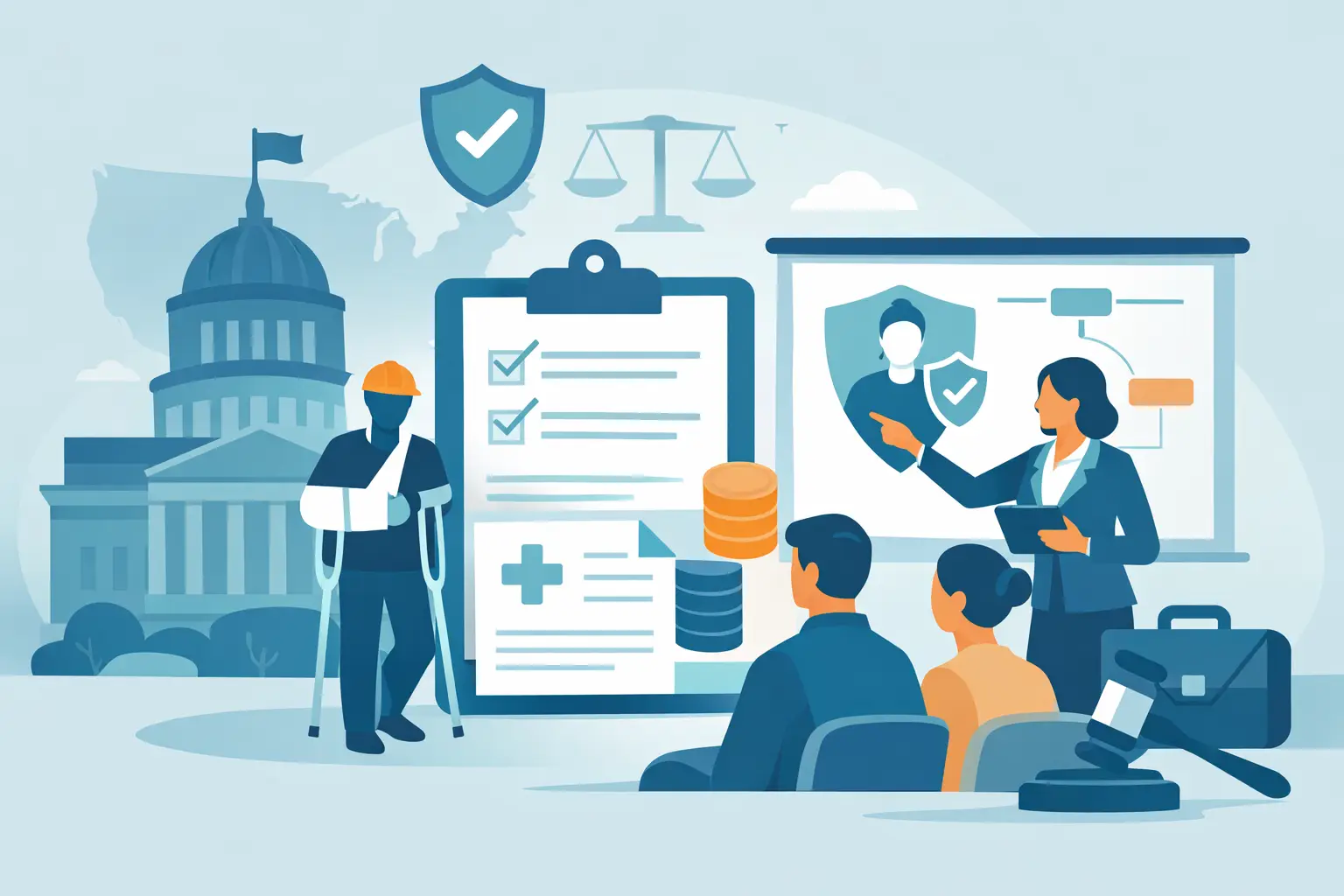
A claim can be handled correctly in one jurisdiction and mishandled in another with the same adjuster, the same employer, and the same injury facts. That is why state workers compensation training modules matter. They are not administrative add-ons. They are operational controls that help claims teams, risk professionals, nurse case managers, and employer stakeholders apply the right rules at the right time while still managing the human side of recovery well.
Workers’ compensation is a state-based system, but many training programs are still built as if one national curriculum is enough. It is not. Core principles such as compensability analysis, medical management, return-to-work planning, and communication standards can be taught broadly. Yet deadlines, benefit structures, reporting obligations, utilization review requirements, fee schedules, dispute processes, and employer responsibilities vary meaningfully by state. That variation creates friction when organizations rely on generic onboarding or scattered job-shadowing instead of a formal state education framework.
Why state workers compensation training modules are a business issue
For leaders responsible for claims outcomes, state-specific education is not just about checking a compliance box. It directly affects indemnity duration, litigation rates, reserving accuracy, vendor coordination, and the injured worker experience.
When a team member misunderstands a state deadline, mishandles a notice requirement, or applies the wrong rule for medical authorization, the result is rarely isolated. A small technical error can trigger attorney involvement, delay treatment, confuse the employer, and erode trust with the injured worker. Costs rise, cycle times extend, and the claim becomes harder to recover both medically and operationally.
The opposite is also true. When professionals understand jurisdiction-specific rules and can explain them clearly, claims move with more consistency. Decisions are documented better. Expectations are set earlier. Employers know what to do next. Injured workers receive clearer communication. In many cases, the most valuable outcome is not simply regulatory accuracy. It is a lower-friction claims process that supports return to work and reduces escalation.
That is where many organizations miss the mark. They separate technical compliance from interpersonal skill. In practice, they are connected. A state rule explained poorly still creates confusion. A legally correct decision delivered without empathy can still produce distrust. High-performing training modules should teach both the jurisdictional framework and the communication behaviors needed to apply it under pressure.
What effective state workers compensation training modules should cover
The strongest modules do more than summarize statutes. They translate state requirements into role-based performance. An adjuster, employer representative, and nurse case manager do not need the same level of detail in the same sequence. Each role needs training that reflects the decisions it actually makes.
At a minimum, state-specific modules should address first report requirements, compensability standards, benefit categories, medical treatment rules, return-to-work expectations, dispute pathways, and closure considerations. But coverage alone is not enough. The content has to answer the practical question every learner is asking: what changes in my workflow because this claim is in this state?
That means using realistic claim scenarios. It means showing how one state may require different documentation timing, a different approach to temporary disability, or a different level of employer engagement. It also means identifying where state law leaves room for judgment, because not every claim decision is a binary compliance matter.
Good modules also distinguish between what is mandatory and what is best practice. That distinction matters. If everything is taught with the same level of urgency, teams struggle to prioritize. Professionals need to know which actions are statutory, which are payer policy, which are client-specific expectations, and which support better outcomes even when they are not explicitly required.
The training gap most organizations still have
Many organizations have state reference materials. Fewer have true state workers compensation training modules built into onboarding, continuing education, and quality assurance. A reference library is helpful, but it is not training.
Reference tools assume the learner already knows what to look for, when to look for it, and how to interpret it in context. New hires and even experienced professionals moving into a new jurisdiction often do not have that level of fluency. They may know the claim process generally, yet still struggle with state-specific sequencing, required forms, or differences in medical and indemnity administration.
This gap becomes more expensive in multi-state environments. Carriers, TPAs, and self-insured employers often standardize systems and service models across the enterprise, which makes sense operationally. But standardization can create blind spots when jurisdictional differences are treated as exceptions instead of foundational training needs.
The result is predictable. Quality reviews find recurring state errors. Supervisors spend excessive time correcting preventable mistakes. Training becomes reactive. Team confidence drops. Employers notice inconsistency. Injured workers experience avoidable delays and mixed messages.
How to evaluate state workers compensation training modules
Decision-makers should evaluate these programs the same way they evaluate any operational investment: by asking whether the training changes performance, reduces variance, and supports measurable outcomes.
Start with scope. Does the training cover only legal concepts, or does it connect those concepts to actual claim handling decisions? A narrow legal overview may satisfy a basic education need, but it will not necessarily improve file quality or communication quality.
Next, assess role alignment. A one-size-fits-all module often produces one-size-fits-none results. State training should reflect whether the learner is handling claims, coordinating care, managing return-to-work efforts, supporting compliance, or overseeing vendor activity. Role-specific framing improves retention because learners can immediately map the content to their daily work.
Then look at instructional design. Dense slides full of statutes rarely improve execution. Case-based learning, decision pathways, and scenario testing are more useful because they force application. In workers’ compensation, the difference between knowing and doing is where claim cost often lives.
Finally, evaluate whether the modules address communication and expectation-setting. This is not soft content added for tone. It is claims performance content. When teams can explain state timelines, benefit decisions, medical rules, and next steps in clear, respectful language, they reduce confusion-driven escalation. That has direct financial value.
State specificity without operational chaos
A common concern is that state-focused education will make training too fragmented. That concern is valid if the program is built poorly. Teams still need a common claims philosophy, consistent service standards, and shared recovery goals. The answer is not fifty disconnected courses with no unifying model.
The better approach is layered training. Start with a common foundation in claims principles, recovery management, communication, and stakeholder coordination. Then add state workers compensation training modules that localize those principles by jurisdiction. This preserves enterprise consistency while respecting legal reality.
That layered model works especially well for organizations managing growth, acquisition integration, or expansion into new states. It gives leaders a cleaner way to scale capability without pretending that every jurisdiction can be handled from the same playbook.
It also improves onboarding. New professionals can first understand what good workers’ compensation management looks like overall, then learn how state requirements shape execution. That sequence is more effective than dropping a new hire into a maze of state references and expecting confidence to appear through repetition.
Why human-centered training belongs in state education
The industry often talks about technical accuracy and empathy as separate competencies. In practice, they should be trained together. State-specific complexity increases the need for effective communication because injured workers and employers are trying to navigate rules they do not understand.
An adjuster may know that a benefit decision is correct under state law. But if that decision is communicated with vague language, poor timing, or no explanation of the next step, the claim can still derail. The worker feels dismissed. The employer feels uninformed. Friction builds around a legally sound process.
That is why advanced training models increasingly connect state education to whole-person recovery principles. Technical compliance matters. So do clarity, respect, and expectation-setting. When organizations teach both together, they create professionals who can move a claim forward without making the process feel adversarial.
This is also where training ROI becomes clearer. Better communication is not merely a cultural preference. It supports treatment adherence, employer engagement, return-to-work planning, and reduced misunderstanding. Those outcomes influence duration and cost.
WorkCompCollege has built its educational model around that reality, treating technical knowledge and human-centered execution as complementary rather than optional.
What better implementation looks like
If your organization is revisiting its training strategy, start by identifying where state variance is creating the most risk. It may be first report handling, compensability decisions, medical management, or return-to-work coordination. Build from those pressure points rather than trying to solve everything at once.
Then align training to measurable outcomes. If the goal is lower litigation, the modules should address not only state dispute procedures but also communication behaviors that reduce preventable escalation. If the goal is faster return to work, the training should connect state benefit rules with employer engagement and functional recovery planning.
It also helps to treat state education as a living system. Rules change. Forms change. Interpretations shift. Teams need refreshers, not just one-time exposure. Organizations that perform well over time usually combine formal modules with ongoing reinforcement through quality review, coaching, and case discussion.
The most effective training does not make workers’ compensation feel simpler than it is. It makes complexity more manageable, more consistent, and more human. In a state-based system, that is not a luxury. It is part of what professional excellence looks like.