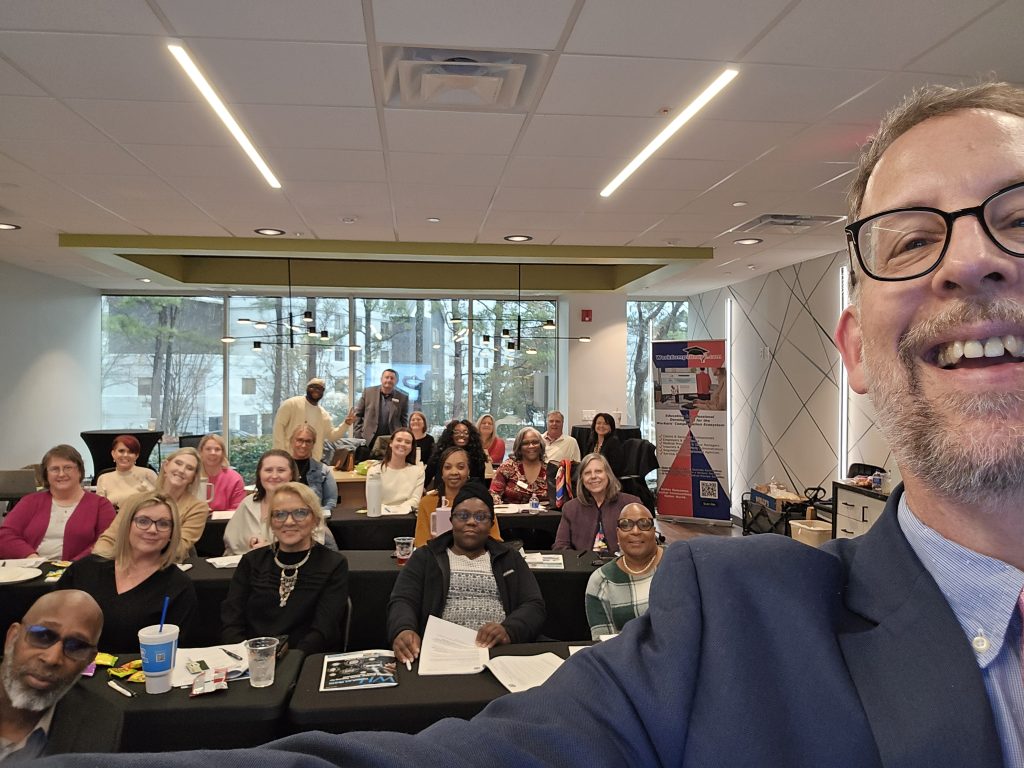

On February 26, WorkCompCollege.com and Workplace Health hosted the first ever “WCMICS Live.” WCMICS is the “Workers’ Comp Mental Injury Claims Specialist” certification that WorkCompCollege.com launched in Fall 2025. I served as moderator for the all-day event and specifically designed it to be a hybrid learning experience. We watched short video excerpts from the WCMICS faculty together then paused to discuss, challenge assumptions, and apply what we heard to real-world scenarios. I even created a 42-page study guide for the students to give them an opportunity to take notes.
After spending eight plus hours together with lively discussion throughout, I asked a simple question to end the day: What did you learn that you can actually apply when you get back to work?
That’s the real test. Not what sounds good in the room, but what behavior changes afterward. If you’ve ever heard me speak, you know I always strive to turn academics into action.
The answers were telling.
One of the most consistent themes as we went around the room was a shift toward seeing the injured worker more holistically. As one attendee put it, “We need to think of them in totality, both from a bio and a psychosocial evaluation.” That may sound obvious, but in practice, workers’ compensation has historically emphasized the physical injury while underestimating – or outright ignoring – the psychological and social factors that often drive the duration and complexity of a claim. Another participant reinforced that reality by noting that if we ignore what’s happening in someone’s personal life – divorce, financial stress, prior mental health history, etc. – we risk missing the very things that are prolonging recovery. That’s not a philosophical issue; it’s an outcomes issue.
Another shift came in how attendees viewed the “subjectivity” of mental injury claims. There is a long-standing belief in the workers’ compensation ecosystem that psychological conditions cannot be measured or validated in the same way as physical injuries. That belief started to break down during the session. As one attendee shared, “I always thought psych was just subjective … but now I see there are validation tools that make it more objective.” Whether it was understanding screening tools, recognizing the role of structured assessments, or applying frameworks like FIDOC, the takeaway was clear: this isn’t guesswork. There are ways to evaluate, validate, and challenge information in a disciplined, transparent, evidence-based manner. Several attendees mentioned that they now know what to look for in a report. Just as importantly, they now know what questions to ask when something doesn’t add up.
Communication and documentation – concepts that everyone in work comp is familiar with – took on a different level of importance in this context. One attendee said it best: “You don’t build a house on a bad foundation … communication and documentation are key.” In mental injury (or “psych”) claims, that foundation becomes even more critical because so much of the claim is shaped by conversations, perceptions, and recorded observations. Another participant made a comment that stuck with me: “There’s really no such thing as a casual conversation when psych is involved … everything matters.” That’s a powerful reminder that what may feel like routine dialogue can ultimately influence claim direction, credibility assessments, and even litigation outcomes.
There was also an honest admission from several attendees who had been hesitant to engage in deeper conversations with injured workers. As one person shared, “I’ve shied away from asking those kinds of questions … I didn’t want to open Pandora’s box.” That concern is real and it’s common. By the end of the session, that hesitation had shifted into something more productive: a recognition that understanding context is not about creating problems but about uncovering what’s already there. When handled correctly, those conversations don’t complicate the claim. They clarify it.
That ultimately led to the most important takeaway of the day: everyone was committed to doing something different. This wasn’t a theoretical discussion, but something that inspired change. I have advocated for a biopsychosocial approach since 2011 and am now the Provost of the change agent that is WorkCompCollege.com. The aspiration for change was music to my ears.
Attendees talked about asking better, open-ended questions and actually listening to (then documenting) the answers. They talked about setting clearer expectations with providers and holding them accountable for more thorough documentation. They talked about reviewing reports more critically instead of accepting them at face value and paying closer attention to medication interactions. They reinforced the need to be more intentional about building trust, starting with the very first interaction with all of the stakeholders, especially the injured worker and their family or support structure.
The takeaways weren’t about replacing what works. Instead, it was about expanding it to reflect the reality of today’s claims environment.
The full WCMICS online curriculum is designed to be practical and immediately applicable, reinforcing concepts like early identification, structured investigation, and coordinated communication across stakeholders. But what matters more than the structure is the shift in mindset that comes from the education. Moving from a purely physical focus to a whole-person approach. From assuming subjectivity to applying structure. From reacting to being intentional.
Because at the end of the day, these aren’t just claims. They’re people trying to get back to their jobs, their families, and their lives.
If that’s the lens we use to approach our work, better outcomes will follow.