
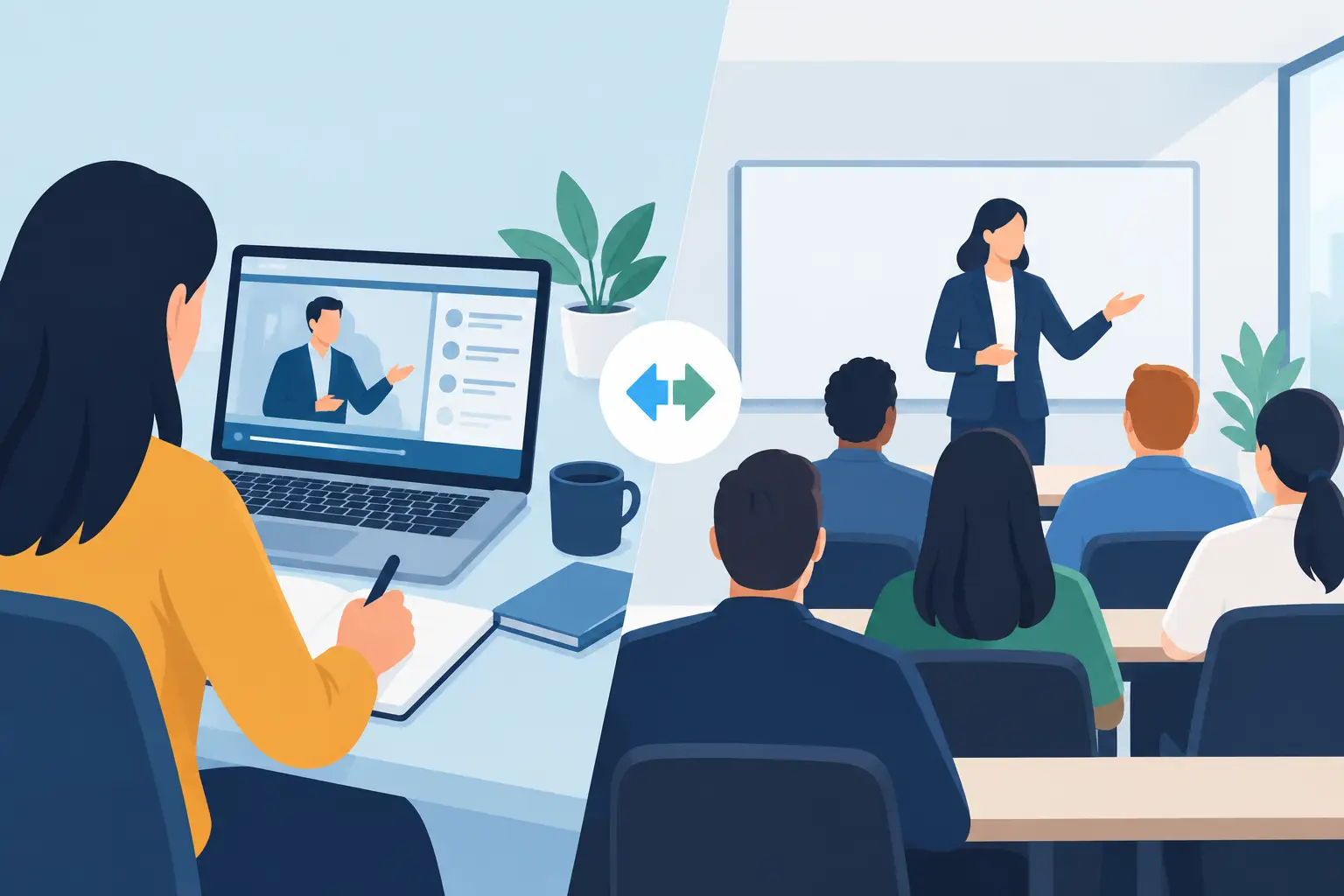
A claims organization rarely chooses training because the calendar has an open afternoon. It chooses training because claim handling is inconsistent, new hires need to become productive faster, regulatory requirements have changed, or outcomes signal a deeper capability gap. The question is not simply whether a training platform vs in person approach is better. The question is which learning model will change behavior where it matters: in conversations with injured workers, return-to-work planning, documentation, compliance decisions, and escalation management.
For workers’ compensation organizations, the answer is often more nuanced than a preference for digital convenience or classroom tradition. The right format depends on the skill being developed, the operational problem being solved, the size and distribution of the workforce, and the degree of accountability leadership expects after the course ends.
Training Platform vs In Person: Start With the Business Need
A training platform is designed for repeatability. It gives organizations a consistent curriculum, role-specific pathways, progress tracking, knowledge assessment, and the ability to deliver education across offices, states, and time zones. For a carrier, TPA, self-insured employer, or provider organization, that consistency can address one of the most expensive hidden risks in claims operations: every professional applying a different standard.
In-person training is designed for immediacy and interaction. A skilled facilitator can read the room, challenge assumptions, work through complicated claim scenarios, and address the real barriers a team faces. This format can be especially valuable when an organization is changing its claims philosophy, repairing a fractured culture, or preparing leaders to handle difficult conversations that cannot be reduced to a multiple-choice assessment.
Neither format is inherently superior. The practical mistake is using one modality for every objective. Compliance education, foundational onboarding, certification coursework, and recurring technical refreshers are usually well suited to a platform. Practice-heavy work such as coaching adjusters through conflict, refining supervisor feedback, or aligning leaders around whole-person recovery may benefit from facilitated discussion and live scenario work.
What a Training Platform Does Better
The strongest argument for a platform is not that it is less expensive than a classroom. It is that it turns training from an event into an operating system.
When learning lives in a structured digital environment, organizations can assign the same required content to every relevant role, verify completion, document competency, and update modules when laws, regulations, or internal procedures change. That matters in workers’ compensation, where state-specific rules, Medicare Secondary Payer considerations, privacy obligations, and jurisdictional variation create real exposure when knowledge is informal or outdated.
A platform also supports learning at the point of need. An adjuster managing a complex lost-time claim does not always need to wait for the next quarterly workshop to refresh a concept. A nurse case manager onboarding into a new account needs a clear sequence of knowledge, not a binder of disconnected reference materials. A risk manager needs evidence that assigned education was completed and understood. Digital learning makes those needs more manageable.
Scalability is another operational advantage. A single in-person session may be highly effective for 25 people, but it becomes difficult to replicate with the same quality across hundreds of employees, multiple offices, high turnover, and shifting schedules. A training platform provides a common baseline while allowing organizations to build pathways by function, tenure, jurisdiction, or client need.
This is particularly important for soft skills. Communication, empathy, expectation-setting, and motivational interviewing are sometimes treated as intangible values rather than measurable professional capabilities. They are not. In workers’ compensation, the way a claim professional explains benefits, sets recovery expectations, responds to frustration, and coordinates stakeholders can influence trust, attorney involvement, treatment adherence, and return-to-work momentum. A well-designed platform can make these skills part of formal learning requirements rather than leaving them to individual personality or local management style.
Where In-Person Training Still Earns Its Place
Digital training can establish knowledge and reinforce standards. It cannot always replicate the pressure of explaining a disputed decision to an upset injured worker, facilitating a difficult employer conversation, or responding when a treating provider, attorney, and claim file point in different directions.
In-person settings are particularly effective when the learning objective requires observation, practice, and feedback. Participants can role-play a first contact call, examine a complicated claim chronology together, or compare how different language choices affect an injured worker’s understanding of the process. An experienced instructor can pause the exercise, identify a missed opportunity, and ask the group to try again.
That level of live coaching is valuable for leadership development as well. Frontline managers must do more than know procedures. They need to recognize patterns in file quality, coach for judgment rather than rote compliance, and connect individual performance to outcomes such as duration, litigation, reserve accuracy, and employee experience. Those conversations often become more productive when leaders are removed from daily production demands and placed in a facilitated environment.
There is also a cultural benefit. When a team gathers to examine the human and financial consequences of claims decisions, the organization signals that its standards are serious. This can be especially useful during a new program launch, a merger, a service model change, or a period of elevated litigation or delayed return-to-work results.
Still, classroom training has limits. It can be difficult to schedule, costly to travel for, and vulnerable to knowledge decay when there is no follow-up. A compelling workshop without reinforcement may create enthusiasm but not sustained practice.
The ROI Question Is About Application, Not Attendance
Executives should be cautious about measuring training success through completion rates alone. Completion is evidence of exposure, not evidence of changed performance.
The more useful question is whether training improves the indicators the organization is trying to influence. Depending on the initiative, that may include time to initial contact, documentation quality, claims audit results, timely referral patterns, return-to-work coordination, attorney representation rates, complaint trends, cycle time, or supervisor confidence in coaching. The appropriate measures should be established before deployment, with a baseline that allows leaders to distinguish activity from impact.
A platform creates a strong audit trail and makes it easier to connect participation data with operational results. In-person learning can reveal barriers that performance dashboards do not explain. For example, a live session may uncover that adjusters understand a communication standard but lack authority, templates, or manager reinforcement to apply it. That insight is not a failure of training. It is evidence that performance improvement requires process and leadership support alongside education.
Training also needs protected time. If employees are expected to complete coursework between escalating emails and statutory deadlines, the organization has communicated that learning is secondary. If managers do not reinforce the skill after a workshop, participants quickly return to established habits. ROI improves when training is embedded in onboarding, quality assurance, coaching, and advancement expectations.
A Blended Model Often Produces the Strongest Result
For most workers’ compensation organizations, the practical answer is not training platform or in person. It is a deliberate blend.
Use a platform to create the common language: technical foundations, compliance requirements, jurisdictional content, certification pathways, standardized onboarding, and recurring reinforcement. Use live instruction where it adds distinct value: applied case consultation, role-play, executive alignment, manager coaching, and difficult judgment calls. Then reinforce both formats through job aids, calibration sessions, supervisor feedback, and measurable expectations.
WorkCompCollege’s education model reflects this principle by treating technical competence and human-centered claims practice as connected disciplines. A professional who understands compensability but cannot establish trust may still create friction. A professional who communicates with empathy but lacks regulatory and medical-management knowledge may still expose the organization to risk. Claims performance requires both.
The best format is the one that gives your people the capability to make better decisions when the claim is complicated, the injured worker is uncertain, and the cost of poor communication is no longer theoretical. Build the learning system around that moment, and the format decision becomes much clearer.